


Page 27 - (DK) Smithsinian - Military History: The Definitive Visual Guide to the Objects of Warfare
P. 27
25
javelins and swords. However, almost as soon as dominance was short-lived and Greece fell into KEY EVENTS
Sparta emerged victorious in 404bce, its power civil wars, ending with the rise of Macedon, first 725–300bce
was challenged by the Thebans, led by Epaminondas. under Philip II and then Alexander the Great.
The Macedonians further deepened the phalanx ◼ c.725–700bce The earliest
known war between Greek
THE EVOLUTION OF THE PHALANX to 16 ranks, and their soldiers carried the sarissa, a city-states (the Lelantine War HOPLITES AND
The Thebans deepened their phalanxes to 12 ranks longer spear of up to 20 feet (6m), which allowed between Chalcis and Eretria) is
or more, made greater use of cavalry, and trained the first five rows to strike at the enemy. These thought to have been fought in
this period. Hoplite armor is also
an elite force known as the Sacred Band. This helped armored “phalangites” kept enemy infantry pinned thought to originate in this era.
them win a stunning victory at Leuctra, in 371bce, down, while heavy cavalry, slingers, and peltasts
which broke Spartan supremacy. However, Theban launched their attack. ◼ c.650bce The earliest depiction
of hoplites in art shows them without
swords, but carrying two spears: one
for thrusting and one for throwing.
“Like some ferocious beast as it turns at bay ◼ 492–90bce The first Greco- PHALANXES
Persian War takes place. Darius I
and stiffens its bristles” of Persia invades Greece, attracting
some allies in the north, but is
defeated by the Athenians and
PLUTARCH, DESCRIBING THE APPEARANCE OF A PHALANX, c.100ce their Plataean allies at the Battle
of Marathon (490bce), in which
the Plataean hoplites surprise the
Persians by charging into their ranks.
◼ 431–04bce Spartan and
Athenian forces clash in the
Peloponnesian War.
◼ 480bce Xerxes launches the
second Persian invasion of Greece.
The Persians are delayed by Spartan
resistance at Thermopylae (480bce).
They are then defeated at Salamis
(480bce) by the Athenian navy, and
at Plataea (479bce), where Spartan
hoplites break through the Persian
line, causing the Persian army to flee.
◼ 378bce The Thebans, under
Epaminondas, destroy the Spartan
army at the Battle of Leuctra,
marking the beginning of the
eclipse of traditional hoplite forces.
◼ 338bce At Chaeronea, Philip II
of Macedon defeats the Thebans
by feigning a withdrawal, stretching
one wing of the Theban army
in pursuit. Philip’s son, Alexander,
then charges the enemy’s left wing
with cavalry, routing it. The Theban
Sacred Band is destroyed.
◼ 331bce The Battle of Gaugamela
takes place. A Macedonian attack
on the left wing of the Persian army,
opens up a gap in their ranks, into
which Alexander advances. This
flexible approach is far in advance
of traditional hoplite tactics.
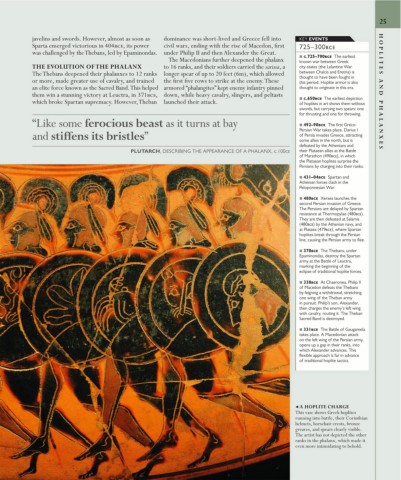
◀ A HOPLITE CHARGE
This vase shows Greek hoplites
running into battle, their Corinthian
helmets, horsehair crests, bronze
greaves, and spears clearly visible.
The artist has not depicted the other
ranks in the phalanx, which made it
even more intimidating to behold.

