


Page 26 - (DK) Smithsinian - Military History: The Definitive Visual Guide to the Objects of Warfare
P. 26
24

         CE   KEY BATTLE                 KEY DEVELOPMENT
              SALAMIS
         O 500  480bce                   HOPLITES AND PHALANXES

              During the second Persian invasion
              of Greece, Athenian admiral
         ORDS   T  Themistocles tricked Xerxes’s   Around 700BCE, a new type of foot soldier emerged in Greece. The
              Persian flotilla—three times the
                                         hoplite, equipped with a long spear, a sword, an elaborate bronze corselet
              size of Themistocles’ force of 378
                                         and helmet, and a large wooden shield (aspis, or hoplon), would form the
              triremes—into entering the Straits
              of Salamis. In the narrow waterway,
                                         backbone of Greek armies for the next 500 years.
              the Persian force could not exercise
         AND SW  its numerical advantage, and was   The earliest examples of hoplite equipment date   With the Persians defeated, Sparta and Athens
              badly mauled by the Greek ships.
                                         back to about 710bce, and within half a century of  clashed for almost the next 80 years, resulting
                                         this date, depictions on vases show hoplites fighting  in the Peloponnesian War (431–04bce), which,

         TS                              in their signature tactical formation—the phalanx.  although bloody, showed only a few innovations in
                                         Composed of rows of spear-wielding hoplites, the  equipment and tactics. The armies began to make
                                         phalanx was normally eight men deep. With spears
                                                                                        more use of archers, and employed flexible light
         CHARIO                          first three ranks could reach the enemy line, but
                                         of around 95–105in (240–70cm) in length, only the  infantry, called peltasts, as skirmishers, armed with
                                         the phalanx’s structure presented a fearsome barrier.


                                         In the 7th and 6th centuries bce, the main hoplite
              ▲ The Greek navy triumphed   THE AGE OF THE HOPLITE
              at Salamis through ingenious    tactic involved colliding with the opposing phalanx,
              use of the terrain and waterways.
                                         followed by concerted pushing and stabbing. There
                                         was little tactical sophistication, and the encounters
                                         continued until one side broke and fled. Only
                                         the hoplite’s left side was fully protected, thanks
                                                  to the hoplon (shield) of the man next to
                                                     him: as a result, the phalanx tended
                                                      to drift to the right, as each man
                                                       tried to edge behind the hoplon
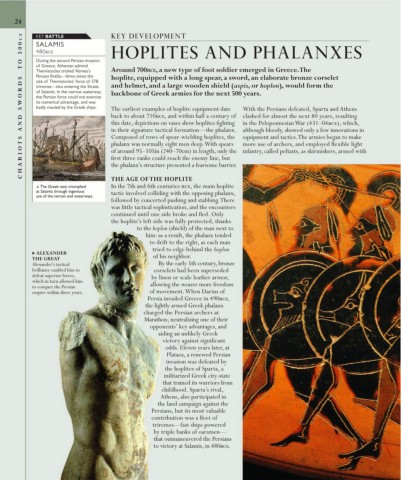
            ▶ ALEXANDER                                 of his neighbor.
            THE GREAT
            Alexander’s tactical                         By the early 5th century, bronze
            brilliance enabled him to                   corselets had been superseded
            defeat superior forces,                    by linen or scale leather armor,
            which in turn allowed him                  allowing the wearer more freedom
            to conquer the Persian
            empire within three years.                of movement. When Darius of
                                                      Persia invaded Greece in 490bce,
                                                     the lightly armed Greek phalanx
                                                    charged the Persian archers at
                                                    Marathon, neutralizing one of their
                                                      opponents’ key advantages, and
                                                         aiding an unlikely Greek
                                                           victory against significant
                                                            odds. Eleven years later, at
                                                            Plataea, a renewed Persian
                                                            invasion was defeated by
                                                            the hoplites of Sparta, a
                                                           militarized Greek city-state
                                                           that trained its warriors from
                                                           childhood. Sparta’s rival,
                                                          Athens, also participated in
                                                         the land campaign against the
                                                       Persians, but its most valuable
                                                       contribution was a fleet of
                                                       triremes—fast ships powered
                                                        by triple banks of oarsmen—
                                                        that outmaneuvered the Persians
                                                        to victory at Salamis, in 480bce.

