


Page 29 - (DK) Smithsinian - Military History: The Definitive Visual Guide to the Objects of Warfare
P. 29
27


                           “Bird-shaped” grip                 Wide leaf-shaped blade                                       Broken tip
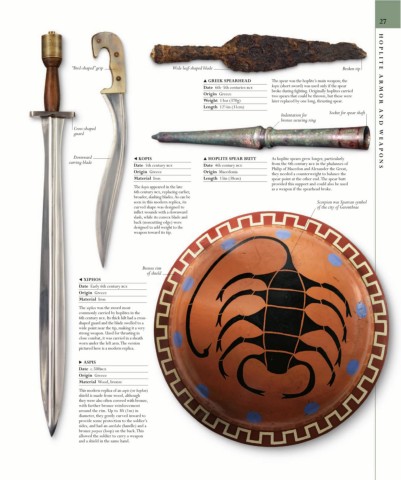
                                                                         ▲ GREEK SPEARHEAD        The spear was the hoplite’s main weapon; the
                                                                         Date  6th–5th centuries bce  kopis (short sword) was used only if the spear
                                                                                                  broke during fighting. Originally hoplites carried
                                                                         Origin  Greece           two spears that could be thrown, but these were
                                                                         Weight  13oz (370g)      later replaced by one long, thrusting spear.  HOPLITE ARMOR AND  WEAPONS
                                                                                 1
                                                                         Length  12 ⁄4in (31cm)
                                                                                                                      Socket for spear shaft
                                                                                                     Indentation for
                                                                                                     bronze securing ring
                           Cross-shaped
                           guard


                           Downward              ◀ KOPIS                 ▲ HOPLITE SPEAR BUTT     As hoplite spears grew longer, particularly
                         curving blade                                                            from the 4th century bce in the phalanxes of
                                                 Date  5th century bce   Date  4th century bce
                                                                                                  Philip of Macedon and Alexander the Great,
                                                 Origin  Greece          Origin  Macedonia
                                                                                                  they needed a counterweight to balance the
                                                 Material  Iron          Length  15in (38cm)      spear point at the other end. The spear butt
                                                                                                  provided this support and could also be used
                                                 The kopis appeared in the late                   as a weapon if the spearhead broke.
                                                 6th century bce, replacing earlier,
                                                 broader, slashing blades. As can be
                                                 seen in this modern replica, its                                 Scorpion was Spartan symbol
                                                 curved shape was designed to                                     of the city of Geronthrae
                                                 inflict wounds with a downward
                                                 slash, while its convex blade and
                                                 back (noncutting edge) were
                                                 designed to add weight to the
                                                 weapon toward its tip.


                                                    Bronze rim
                                                     of shield
                             ◀ XIPHOS
                             Date  Early 6th century bce
                             Origin  Greece
                             Material  Iron
                             The xiphos was the sword most
                             commonly carried by hoplites in the
                             6th century bce. Its thick hilt had a cross-
                             shaped guard and the blade swelled to a
                             wide point near the tip, making it a very
                             strong weapon. Used for thrusting in
                             close combat, it was carried in a sheath
                             worn under the left arm. The version
                             pictured here is a modern replica.

                             ▶ ASPIS
                             Date  c.500bce
                             Origin  Greece
                             Material  Wood, bronze
                             This modern replica of an aspis (or hoplon)
                             shield is made from wood, although
                             they were also often covered with bronze,
                             with further bronze reinforcement
                             around the rim. Up to 3ft (1m) in
                             diameter, they gently curved inward to
                             provide some protection to the soldier’s
                             sides, and had an antilabe (handle) and a
                             bronze porpax (loop) on the back. This
                             allowed the soldier to carry a weapon
                             and a shield in the same hand.

