


Page 336 - (DK) Smithsinian - Military History: The Definitive Visual Guide to the Objects of Warfare
P. 336
334    CRUISERS

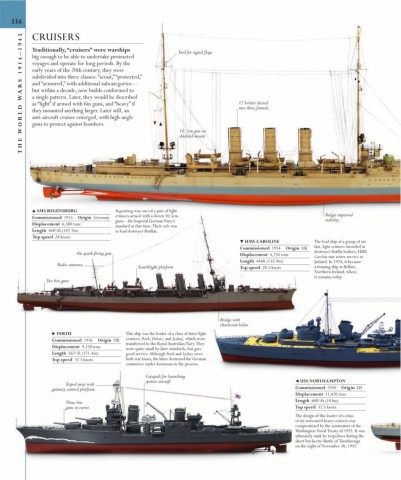
         1914–1945  Traditionally, “cruisers” were warships     Yard for signal flags


            big enough to be able to undertake protracted
            voyages and operate for long periods. By the

            subdivided into three classes: “scout,” “protected,”
         ARS   early years of the 20th century, they were
            and “armored,” with additional subcategories—
            but within a decade, new builds conformed to
            a single pattern. Later, they would be described
         ORLD W  as “light” if armed with 6in guns, and “heavy” if                    12 boilers ducted
                                                                                      into three funnels
            they mounted anything larger. Later still, an
            anti-aircraft cruiser emerged, with high-angle
            guns to protect against bombers.
         THE W                                                   10.5cm gun on
                                                                 shielded mount


            ▲ SMS REGENSBURG              Regensburg was one of a pair of light
            Commissioned  1915     Origin  Germany  cruisers armed with a dozen 10.5cm                               Bulges improved
                                          guns—the Imperial German Navy’s                                            stability
            Displacement  6,380 tons
                                          standard at that time. Their role was
                    1
            Length  468 ⁄4ft (142.7m)     to lead destroyer flotillas.
             Top speed  28 knots
                                                                                       ▼ HMS CAROLINE            The lead ship of a group of six
                                                                                       Commissioned  1914     Origin  UK  fast, light cruisers intended as
                            4in quick-firing gun                                       Displacement  4,735 tons  destroyer flotilla leaders, HMS
                                                                                                                 Caroline saw active service at
                                                                                       Length  446ft (135.9m)    Jutland. In 1924, it became
                     Radio antenna
                                                  Searchlight platform                 Top speed  28.5 knots     a training ship at Belfast,
                                                                                                                 Northern Ireland, where
                                                                                                                 it remains today.
                 Two 6in guns


                                                                               Bridge with
                                                                               chartroom below
                   ▶ PERTH                    This ship was the leader of a class of three light
                   Commissioned  1936     Origin  UK  cruisers, Perth, Hobart, and Sydney, which were
                                              transferred to the Royal Australian Navy. They
                   Displacement  9,150 tons   were quite small by later standards, but gave
                            1
                   Length  562 ⁄2ft (171.4m)  good service. Although Perth and Sydney were
                   Top speed  32.5 knots      both war losses, the latter destroyed the German
                                              commerce raider Kormorant in the process.
                                                     Catapult for launching
                                                     spotter aircraft                                     ◀ USS NORTHAMPTON
                        Tripod mast with
                   gunnery control platform                                                               Commissioned  1930     Origin  US
                                                                                                          Displacement  11,420 tons
                                                                                                                  1
                                                                                                          Length  600 ⁄4ft (183m)
                        Three 6in
                        guns in turret                                                                    Top speed  32.5 knots
                                                                                                          The design of this leader of a class
                                                                                                          of six armoured heavy cruisers was
                                                                                                          compromised by the constraints of the
                                                                                                          Washington Naval  Treaty of 1922. It was
                                                                                                          ultimately sunk by torpedoes during the
                                                                                                          short but hectic Battle of  Tassafaronga
                                                                                                          on the night of November 30, 1942.

