


Page 338 - (DK) Smithsinian - Military History: The Definitive Visual Guide to the Objects of Warfare
P. 338
336
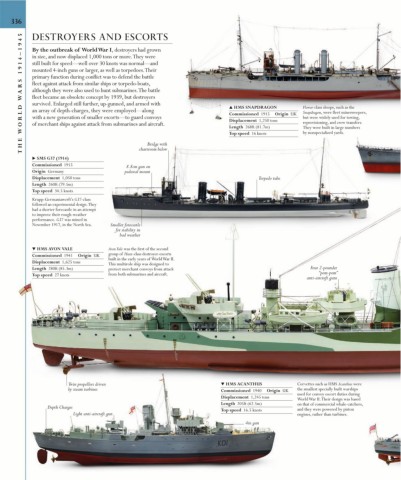
     336    DESTROYERS AND ESCORTS
         1914–1945  By the outbreak of   World War I, destroyers had grown


            in size, and now displaced 1,000 tons or more. They were
            still built for speed—well over 30 knots was normal—and

            primary function during conflict was to defend the battle
         ARS   mounted 4-inch guns or larger, as well as torpedoes. Their
            fleet against attack from similar ships or torpedo-boats,
            although they were also used to hunt submarines. The battle
            fleet became an obsolete concept by 1939, but destroyers
         ORLD W  survived. Enlarged still further, up-gunned, and armed with       ▲ HMS SNAPDRAGON          Flower-class sloops, such as the
            an array of depth-charges, they were employed—along
                                                                                                             Snapdragon, were fleet minesweepers,
                                                                                   Commissioned  1915     Origin  UK
            with a new generation of smaller escorts—to guard convoys
                                                                                                             but were widely used for towing,
                                                                                   Displacement  1,250 tons
                                                                                                             reprovisioning, and crew transfers.
            of merchant ships against attack from submarines and aircraft.
         THE W                                     chartroom below                 Length  268ft (81.7m)     They were built in large numbers
                                                                                                             by nonspecialized yards.
                                                                                   Top speed  16 knots
                                                     Bridge with
            ▶ SMS G37 (1914)
            Commissioned  1915
                                              8.8cm gun on
            Origin  Germany                  pedestal mount
            Displacement  1,050 tons                                                         Torpedo tube
            Length  260ft (79.5m)
            Top speed  34.5 knots
            Krupp-Germaniawerft’s G37-class
            followed an experimental design. They
            had a shorter forecastle in an attempt
            to improve their rough-weather
            performance. G37 was mined in
            November 1917, in the North Sea.  Smaller forecastle
                                          for stability in
                                            bad weather

            ▼ HMS AVON  VALE            Avon  Vale was the first of the second
            Commissioned  1941     Origin  UK  group of  Hunt-class destroyer-escorts
                                        built in the early years of  World War II.
            Displacement  1,625 tons
                                        This multirole ship was designed to
            Length  280ft (85.3m)       protect merchant convoys from attack                                    Four 2-pounder
            Top speed  27 knots         from both submarines and aircraft.                                         “pom-pom”
                                                                                                              anti-aircraft guns


                         Twin propellers driven                                 ▼ HMS ACANTHUS             Corvettes such as HMS Acanthus were
                         by steam turbines                                      Commissioned  1940     Origin  UK  the smallest specially built warships
                                                                                                           used for convoy escort duties during
                                                                                Displacement  1,245 tons   World War II. Their design was based
                                                                                Length  205ft (62.5m)      on that of commercial whale-catchers,
                  Depth Charges
                                                                                Top speed  16.5 knots      and they were powered by piston
                           Light anti-aircraft gun                                                         engines, rather than turbines.
                                                                                        4in gun

