


Page 337 - (DK) Smithsinian - Military History: The Definitive Visual Guide to the Objects of Warfare
P. 337
335

                                                                  “Siamese” forward funnels are steeply raked  Two 8in guns
                                          Two 8in                                                     in turret                         CR
                                      guns in turret                                                                                    UISERS


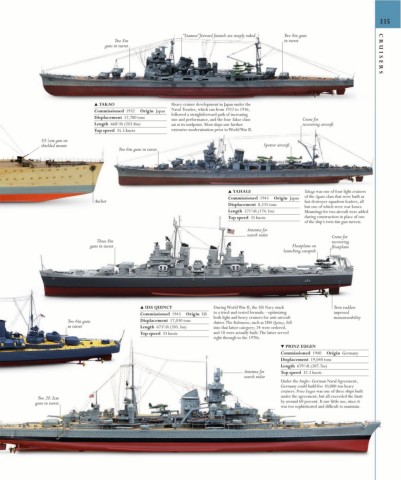
                                   ▲ TAKAO                    Heavy cruiser development in Japan under the
                                   Commissioned  1932     Origin  Japan  Naval  Treaties, which ran from 1922 to 1936,
                                                              followed a straightforward path of increasing
                                   Displacement  12,780 tons  size and performance, and the four Takao-class   Crane for
                                           1
                                   Length  668 ⁄2ft (203.8m)  sat at its midpoint. Most ships saw further    recovering aircraft
                                   Top speed  35.5 knots      extensive modernization prior to World War II.
                10.5cm gun on
                shielded mount                                                                 Spotter aircraft
                                           Two 6in guns in turret


                                                                                  ▲ YAHAGI                    Yahagi was one of four light cruisers
                                                                                  Commissioned  1943     Origin  Japan  of the Agano class that were built as
                                   Anchor                                                                     fast destroyer squadron leaders, all
                                                                                  Displacement  8,535 tons    but one of which were war losses.
                                                                                  Length  571 ⁄4ft (174.1m)   Mountings for two aircraft were added
                                                                                          1
                                                                                  Top speed  35 knots         during construction in place of one
                                                                                                              of the ship’s twin 6in gun turrets.
                                                                                         Antenna for
                                                                                         search radar                  Crane for
                                   Three 8in                                                                           recovering
                                 guns in turret                                                          Floatplane on   floatplane
                                                                                                      launching catapult


                                                   ▲ USS QUINCY              During World War II, the US Navy stuck     Twin rudders
                                                   Commissioned  1943     Origin  US  to a tried-and-tested formula—optimizing   improved
                                                                             both light and heavy cruisers for anti-aircraft   maneuverability
                         Two 6in guns              Displacement  17,030 tons  duties. The Baltimores, such as USS Quincy, fell
                                                           1
                         in turret                 Length  673 ⁄2ft (205.3m)  into that latter category; 24 were ordered,
                                                   Top speed  33 knots       and 18 were actually built. The latter served
                                                                             right through to the 1970s.
                                                                                                     ▼ PRINZ EUGEN
                                                                                                     Commissioned  1940     Origin  Germany
                                                                                                     Displacement  19,040 tons
                                                                                                             1
                                                                                                     Length  679 ⁄2ft (207.7m)
                                                                                        Antenna for   Top speed  32.5 knots
                                                                                        search radar
                                                                                                     Under the Anglo–German Naval Agreement,
                                                                                                     Germany could build five 10,000-ton heavy
                                                                                                     cruisers. Prinz Eugen was one of three ships built
                                                                                                     under the agreement, but all exceeded the limit
              Two 20.3cm
             guns in turret                                                                          by around 60 percent. It saw little use, since it
                                                                                                     was too sophisticated and difficult to maintain.

