


Page 334 - (DK) Smithsinian - Military History: The Definitive Visual Guide to the Objects of Warfare
P. 334
332    BELOW DECKS

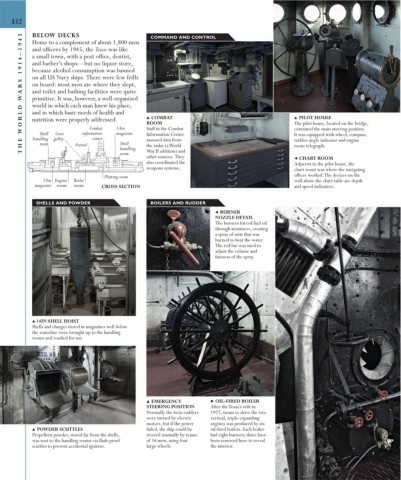
         1914–1945  Home to a complement of about 1,800 men   COMMAND AND CONTROL

            and officers by 1945, the Texas was like
            a small town, with a post office, dentist,
            and barber’s shops—but no liquor store,

            on all US Navy ships.  There were few frills
         ARS   because alcohol consumption was banned
            on board: most men ate where they slept,
            and toilet and bathing facilities were quite
         ORLD W  world in which each man knew his place,   ▲ COMBAT                                       ▲ PILOT HOUSE
            primitive. It was, however, a well-organized
            and in which basic needs of health and
            nutrition were properly addressed.
                                                                                                          The pilot house, located on the bridge,
                                                     ROOM
         THE W  handling  galley   Funnel  Combat   14in   Staff in the Combat                            contained the main steering position.
                              information
                                          magazine
               Shell
                     Crew
                                                     Information Center
                                                                                                          It was equipped with wheel, compass,
                                  center
                                                     assessed data from
                                                                                                          rudder-angle indicator and engine
                                            Shell
               room
                                                     the radar (a World
                                                                                                          room telegraph.
                                            handling
                                                     War II addition) and
                                            room
                                                     other sources.  They                                 ◀ CHART ROOM
                                                     also coordinated the                                 Adjacent to the pilot house, the
                                                     weapons systems.                                     chart room was where the navigating
                                                                                                          officer worked. The devices on the
                                      Plotting room
                14in   Engine   Boiler                                                                    wall above the chart table are depth
             magazine   rooms  rooms  CROSS SECTION                                                       and speed indicators.
              SHELLS AND POWDER                        BOILERS AND RUDDER
                                                                              ◀ BURNER
                                                                              NOZZLE DETAIL
                                                                              The burners forced fuel oil
                                                                              through atomizers, creating
                                                                              a spray of mist that was
                                                                              burned to heat the water.
                                                                              The red bar was used to
                                                                              adjust the volume and
                                                                              fineness of the spray.


            ▲ 14IN SHELL HOIST
            Shells and charges stored in magazines well below
            the waterline were brought up to the handling
            rooms and readied for use.


                                                     ▲ EMERGENCY            ▶ OIL-FIRED BOILER
                                                     STEERING POSITION      After the Texas’s refit in
                                                     Normally the twin rudders   1927, steam to drive the two
                                                     were turned by electric   vertical, triple-expanding
                                                     motors, but if the power   engines was produced by six
            ▲ POWDER SCUTTLES                        failed, the ship could be   oil-fired boilers. Each boiler
            Propellent powder, stored far from the shells,    steered manually by teams    had eight burners; three have
            was sent to the handling rooms via flash-proof    of 16 men, using four    been removed here to reveal
            scuttles to prevent accidental ignition.  large wheels.         the interior.

