


Page 344 - (DK) Smithsinian - Military History: The Definitive Visual Guide to the Objects of Warfare
P. 344
342

         1914–1945   KEY TACTIC
              KAMIKAZE
              1944–45
              In October 1944, Japan began to
              adopt suicide tactics, deliberately
              ships with the aim of crippling or
         ARS   crashing their aircraft into American
              sinking them. The kamikaze (“divine
              wind”) units were initially made up
              of only elite flyers, but, by 1945,
         ORLD W  thousands of poorly trained novice
              suicide attack had become a task for
              pilots. An estimated 322 Allied ships
              were hit by kamikaze planes, and
              at least 34 of them sank.
         THE W


              ▲ A Japanese Zero fighter seen just
              before it crashed into the USS Missouri,
              in 1945. The battleship suffered only
              superficial damage.


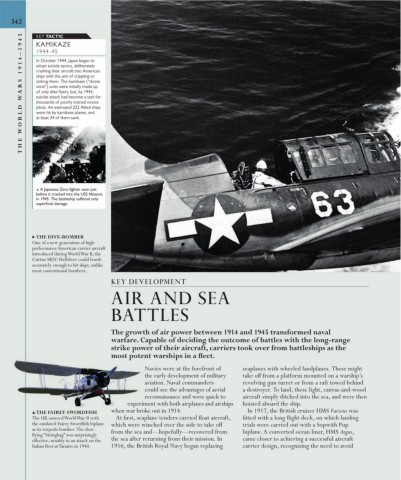
            ▶ THE DIVE-BOMBER
            One of a new generation of high-
            performance American carrier aircraft
            introduced during World War II, the
            Curtiss SB2C Helldiver could bomb
            accurately enough to hit ships, unlike
            most conventional bombers.
                                         KEY DEVELOPMENT
                                         AIR AND SEA


                                         BATTLES


                                         The growth of air power between 1914 and 1945 transformed naval
                                         warfare. Capable of deciding the outcome of battles with the long-range
                                         strike power of their aircraft, carriers took over from battleships as the
                                         most potent warships in a fleet.

                                                     Navies were at the forefront of    seaplanes with wheeled landplanes.  These might
                                                     the early development of military   take off from a platform mounted on a warship’s
                                                     aviation. Naval commanders         revolving gun turret or from a raft towed behind
                                                     could see the advantages of aerial   a destroyer.  To land, these light, canvas-and-wood
                                                     reconnaissance and were quick to   aircraft simply ditched into the sea, and were then
                                              experiment with both airplanes and airships   hoisted aboard the ship.
            ▲ THE FAIREY SWORDFISH       when war broke out in 1914.                     In 1917, the British cruiser HMS Furious was
            The UK entered World War II with   At first, seaplane tenders carried float aircraft,   fitted with a long flight deck, on which landing
            the outdated Fairey Swordfish biplane   which were winched over the side to take off    trials were carried out with a Sopwith Pup
            as its torpedo bomber.  The slow-  from the sea and—hopefully—recovered from    biplane. A converted ocean liner, HMS Argus,
            flying “Stringbag” was surprisingly
            effective, notably in an attack on the   the sea after returning from their mission. In    came closer to achieving a successful aircraft
            Italian fleet at Taranto in 1940.   1916, the British Royal Navy began replacing   carrier design, recognizing the need to avoid

