


Page 342 - (DK) Smithsinian - Military History: The Definitive Visual Guide to the Objects of Warfare
P. 342
340    AMPHIBIOUS INVASION

         1914–1945  THE NORMANDY


         ARS  LANDINGS


            The Allied landings on Normandy beaches on D-day,

         ORLD W  June 6, 1944, comprised the largest amphibious operation
            ever. With around 160,000 soldiers put ashore in a single
            day despite heavy resistance, the invasion was a masterpiece
            of planning and organization on a vast scale.
         THE W  The outcome of the Normandy     other warships and troop transports,

                                                while airborne troops landed by
            landings depended upon experience
            accumulated by the Allies since the
                                                behind the beaches. At dawn Allied
            beginning of  World War II—on Sicily   parachute and glider to seize objectives
            and the Italian mainland, in the    warships, including six battleships,
            Dieppe Raid of 1942, and by US      opened fire on the German Atlantic
            Marines in the Pacific. The most    Wall coastal defenses. This was the
            important lesson learned had been   first warning the German defenders
            never to underestimate the difficulty   had of the impending invasion.
            of such an enterprise.
               Successful landings required     THE FINAL APPROACH
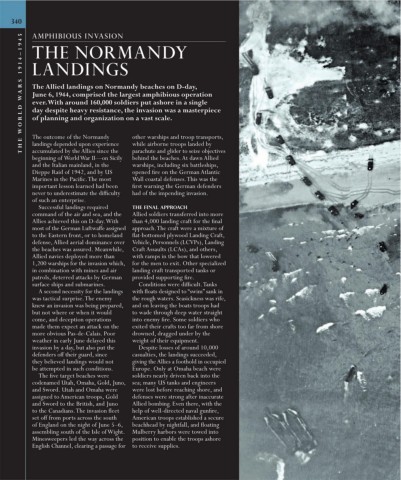
            command of the air and sea, and the   Allied soldiers transferred into more
            Allies achieved this on D-day. With   than 4,000 landing craft for the final
            most of the German Luftwaffe assigned  approach. The craft were a mixture of
            to the Eastern front, or to homeland   flat-bottomed plywood Landing Craft,
            defense, Allied aerial dominance over  Vehicle, Personnels (LCVPs), Landing
            the beaches was assured. Meanwhile,   Craft Assaults (LCAs), and others,
            Allied navies deployed more than    with ramps in the bow that lowered
            1,200 warships for the invasion which,  for the men to exit. Other specialized
            in combination with mines and air   landing craft transported tanks or
            patrols, deterred attacks by German   provided supporting fire.
            surface ships and submarines.         Conditions were difficult. Tanks
               A second necessity for the landings   with floats designed to “swim” sank in
            was tactical surprise. The enemy    the rough waters. Seasickness was rife,
            knew an invasion was being prepared,   and on leaving the boats troops had
            but not where or when it would      to wade through deep water straight
            come, and deception operations      into enemy fire. Some soldiers who
            made them expect an attack on the   exited their crafts too far from shore
            more obvious Pas-de-Calais. Poor    drowned, dragged under by the
            weather in early June delayed this   weight of their equipment.
            invasion by a day, but also put the   Despite losses of around 10,000
            defenders off their guard, since    casualties, the landings succeeded,
            they believed landings would not    giving the Allies a foothold in occupied
            be attempted in such conditions.    Europe. Only at Omaha beach were
               The five target beaches were     soldiers nearly driven back into the
            codenamed Utah, Omaha, Gold, Juno,  sea; many US tanks and engineers
            and Sword. Utah and Omaha were      were lost before reaching shore, and
            assigned to American troops, Gold    defenses were strong after inaccurate
            and Sword to the British, and Juno    Allied bombing. Even there, with the
            to the Canadians. The invasion fleet   help of well-directed naval gunfire,
            set off from ports across the south    American troops established a secure
            of England on the night of June 5–6,   beachhead by nightfall, and floating
            assembling south of the Isle of Wight.  Mulberry harbors were towed into
            Minesweepers led the way across the   position to enable the troops ashore
            English Channel, clearing a passage for  to receive supplies.

