


Page 346 - (DK) Smithsinian - Military History: The Definitive Visual Guide to the Objects of Warfare
P. 346
344    AIRCRAFT CARRIERS

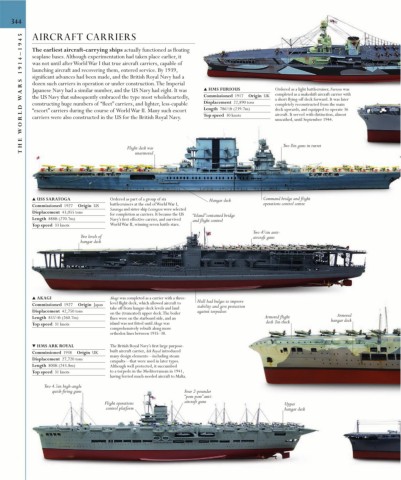
         1914–1945  The earliest aircraft-carrying ships actually functioned as floating


            seaplane bases. Although experimentation had taken place earlier, it
            was not until after World War I that true aircraft carriers, capable of

            significant advances had been made, and the British Royal Navy had a
         ARS   launching aircraft and recovering them, entered service. By 1939,   ▲ HMS FURIOUS   Ordered as a light battlecruiser, Furious was
            dozen such carriers in operation or under construction. The Imperial
            Japanese Navy had a similar number, and the US Navy had eight. It was
                                                                                                   completed as a makeshift aircraft carrier with
                                                                          Commissioned  1917     Origin  UK
            the US Navy that subsequently embraced the type most wholeheartedly,
         ORLD W  constructing huge numbers of  “fleet” carriers, and lighter, less-capable   Displacement  22,890 tons  a short flying-off deck forward. It was later
                                                                                                   completely reconstructed from the main
                                                                                  1
                                                                          Length  786 ⁄2ft (239.7m)
                                                                                                   deck upwards, and equipped to operate 36
            “escort” carriers during the course of  World War II. Many such escort
                                                                                                   aircraft. It served with distinction, almost
                                                                          Top speed  30 knots
            carriers were also constructed in the US for the British Royal Navy.
                                                                                                   unscathed, until September 1944.
          THE W                               Flight deck was                                         Two 8in guns in turret
                                                 unarmored


            ▲ USS SARATOGA              Ordered as part of a group of six   Hangar deck        Command bridge and flight
            Commissioned  1927     Origin  US  battlecruisers at the end of World War I,       operations control centre
                                        Saratoga and sister-ship Lexington were selected
            Displacement  43,055 tons
                                        for completion as carriers. It became the US   “Island” contained bridge
            Length  888ft (270.7m)      Navy’s first effective carrier, and survived   and flight control
            Top speed  33 knots         World War II, winning seven battle stars.
                                                                                               3
                                                                                           Two 4 ⁄4in anti-
                              Two levels of                                                aircraft guns
                              hangar deck


            ▲ AKAGI                     Akagi was completed as a carrier with a three-  Hull had bulges to improve
            Commissioned  1927     Origin  Japan  level flight deck, which allowed aircraft to   stability and give protection
                                        take off from hangar-deck levels and land
            Displacement  42,750 tons   on the (truncated) upper deck. The boiler   against torpedoes
                                                                                                                         Armored
                    1
            Length  855 ⁄2ft (260.7m)   flues were on the starboard side, and an               Armored flight          hangar deck
            Top speed  31 knots         island was not fitted until Akagi was                   deck 3in thick
                                        comprehensively rebuilt along more
                                        orthodox lines between 1935–38.
            ▼ HMS ARK ROYAL             The British Royal Navy’s first large purpose-
            Commissioned  1938     Origin  UK  built aircraft carrier, Ark Royal introduced
                                        many design elements—including steam
            Displacement  27,720 tons   catapults—that were used in later types.
            Length  800ft (243.8m)      Although well protected, it succumbed
            Top speed  31 knots         to a torpedo in the Mediterranean in 1941,
                                        having ferried much-needed aircraft to Malta.

                 Two 4.5in high-angle
                   quick-firing guns                               Four 2-pounder
                                                                   “pom-pom” anti-
                                      Flight operations            aircraft guns                      Upper
                                       control platform                                               hangar deck

