


Page 345 - (DK) Smithsinian - Military History: The Definitive Visual Guide to the Objects of Warfare
P. 345
343


                                                                                                                                        AIR


                                                                                                                                        AND SEA BA


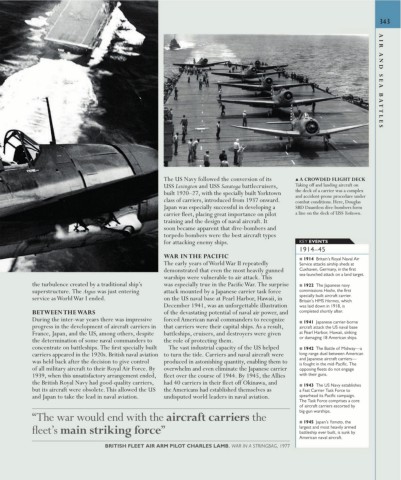
                                                           The US Navy followed the conversion of its     ▲ A CROWDED FLIGHT DECK       TTLES
                                                           USS Lexington and USS Saratoga battlecruisers,   Taking off and landing aircraft on
                                                           built 1920–27, with the specially built  Yorktown   the deck of a carrier was a complex
                                                                                                          and accident-prone procedure under
                                                           class of carriers, introduced from 1937 onward.   combat conditions. Here, Douglas
                                                           Japan was especially successful in developing a   SBD Dauntless dive-bombers form
                                                           carrier fleet, placing great importance on pilot   a line on the deck of USS Yorktown.
                                                           training and the design of naval aircraft. It
                                                           soon became apparent that dive-bombers and
                                                           torpedo bombers were the best aircraft types
                                                           for attacking enemy ships.                       KEY EVENTS
                                                                                                            1914–45
                                                           WAR IN THE PACIFIC                               ◼ 1914  Britain’s Royal Naval Air
                                                           The early years of World War II repeatedly       Service attacks airship sheds at
                                                           demonstrated that even the most heavily gunned   Cuxhaven, Germany, in the first
                                                                                                            sea-launched attack on a land target.
                                                           warships were vulnerable to air attack.  This
            the turbulence created by a traditional ship’s   was especially true in the Pacific War.  The surprise   ◼ 1922  The Japanese navy
            superstructure.  The Argus was just entering   attack mounted by a Japanese carrier task force    commissions Hosho, the first
            service as World War I ended.                  on the US naval base at Pearl Harbor, Hawaii, in   specially built aircraft carrier.
                                                                                                            Britain’s HMS Hermes, which
                                                           December 1941, was an unforgettable illustration   was laid down in 1918, is
            BETWEEN THE WARS                               of the devastating potential of naval air power, and   completed shortly after.
            During the inter-war years there was impressive   forced American naval commanders to recognize   ◼ 1941  Japanese carrier-borne
            progress in the development of aircraft carriers in  that carriers were their capital ships. As a result,   aircraft attack the US naval base
            France, Japan, and the US, among others, despite    battleships, cruisers, and destroyers were given    at Pearl Harbor, Hawaii, sinking
            the determination of some naval commanders to   the role of protecting them.                    or damaging 18 American ships.
            concentrate on battleships.  The first specially built   The vast industrial capacity of the US helped    ◼ 1942  The Battle of Midway—a
            carriers appeared in the 1920s. British naval aviation  to turn the tide. Carriers and naval aircraft were   long-range duel between American
            was held back after the decision to give control    produced in astonishing quantity, enabling them to   and Japanese aircraft carriers—
                                                                                                            is fought in the mid-Pacific. The
            of all military aircraft to their Royal Air Force. By   overwhelm and even eliminate the Japanese carrier   opposing fleets do not engage
            1939, when this unsatisfactory arrangement ended,  fleet over the course of 1944. By 1945, the Allies   with their guns.
            the British Royal Navy had good-quality carriers,   had 40 carriers in their fleet off Okinawa, and    ◼ 1943  The US Navy establishes
            but its aircraft were obsolete. This allowed the US   the Americans had established themselves as   a Fast Carrier Task Force to
            and Japan to take the lead in naval aviation.   undisputed world leaders in naval aviation.     spearhead its Pacific campaign.
                                                                                                            The Task Force comprises a core
                                                                                                            of aircraft carriers escorted by
                                                                                                            big-gun warships.
            “The war would end with the aircraft carriers the
                                                                                                            ◼ 1945  Japan’s Yamato, the
            fleet’s main striking force”                                                                    largest and most heavily armed
                                                                                                            battleship ever built, is sunk by
                                                                                                            American naval aircraft.
                                      BRITISH FLEET AIR ARM PILOT CHARLES LAMB, WAR IN A STRINGBAG, 1977

