


Page 358 - (DK) Smithsinian - Military History: The Definitive Visual Guide to the Objects of Warfare
P. 358
356    WORLD WAR II ARMORED VEHICLE

         1914–1945  T-34 TANK


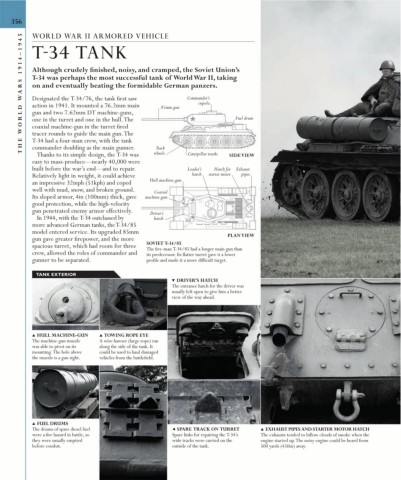
            Although crudely finished, noisy, and cramped, the Soviet Union’s
         ARS   T-34 was perhaps the most successful tank of  World War II, taking
            on and eventually beating the formidable German panzers.

         ORLD W  action in 1941. It mounted a 76.2mm main   85mm gun    cupola       Fuel drum
            Designated the  T-34/76, the tank first saw
                                                                    Commander’s
            gun and two 7.62mm DT machine-guns,
            one in the turret and one in the hull. The
            coaxial machine-gun in the turret fired
         THE W  tracer rounds to guide the main gun. The
            T-34 had a four-man crew, with the tank
            commander doubling as the main gunner.
                                                        Track
              Thanks to its simple design, the  T-34 was   wheels   Caterpillar tracks  SIDE VIEW
            easy to mass-produce—nearly 40,000 were
            built before the war’s end—and to repair.               Loader’s   Hatch for  Exhaust
            Relatively light in weight, it could achieve             hatch  starter motor  pipes
            an impressive 32mph (51kph) and coped     Hull machine-gun
            well with mud, snow, and broken ground.     Coaxial
            Its sloped armor, 4in (100mm) thick, gave   machine-gun
            good protection, while the high-velocity
            gun penetrated enemy armor effectively.
                                                      Driver’s
              In 1944, with the  T-34 outclassed by     hatch
            more advanced German tanks, the T-34/85
            model entered service. Its upgraded 85mm
            gun gave greater firepower, and the more                              PLAN VIEW
            spacious turret, which had room for three   SOVIET  T-34/85
                                                     The five-man  T-34/85 had a longer main gun than
            crew, allowed the roles of commander and   its predecessor. Its flatter turret gave it a lower
            gunner to be separated.                  profile and made it a more difficult target.


              TANK EXTERIOR
                                                              ▼ DRIVER’S HATCH
                                                              The entrance hatch for the driver was
                                                              usually left open to give him a better
                                                              view of the way ahead.


            ▲ HULL MACHINE-GUN      ▲ TOWING ROPE EYE
            The machine-gun muzzle    A wire hawser (large rope) ran
            was able to pivot on its   along the side of the tank. It
            mounting.  The hole above    could be used to haul damaged
            the muzzle is a gun sight.  vehicles from the battlefield.


            ▲ FUEL DRUMS
            The drums of spare diesel fuel                    ◀ SPARE  TRACK ON  TURRET       ▲ EXHAUST PIPES AND STARTER MOTOR HATCH
            were a fire hazard in battle, so                  Spare links for repairing the  T-34’s    The exhausts tended to billow clouds of smoke when the
            they were usually emptied                         wide tracks were carried on the    engine started up. The noisy engine could be heard from
            before combat.                                    outside of the tank.            500 yards (450m) away.

