


Page 360 - (DK) Smithsinian - Military History: The Definitive Visual Guide to the Objects of Warfare
P. 360
358    ANTI-TANK WEAPONS

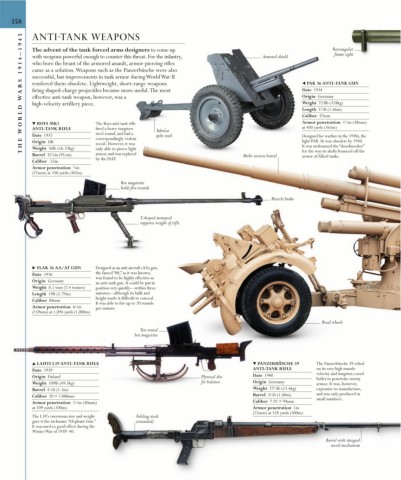
         1914–1945  The advent of the tank forced arms designers to come up                    Armored shield           Rectangular


                                                                                                                        frame sight
            with weapons powerful enough to counter this threat. For the infantry,
            who bore the brunt of the armored assault, armor-piercing rifles
            successful, but improvements in tank armor during World War II
         ARS   came as a solution. Weapons such as the Panzerbüsche were also                                ◀ PAK 36 ANTI-TANK GUN
            rendered them obsolete. Lightweight, short-range weapons
            firing shaped-charge projectiles became more useful. The most
                                                                                                             Date  1934
                                                                                                             Origin  Germany
            effective anti-tank weapon, however, was a
         ORLD W  high-velocity artillery piece. The Boys anti-tank rifle                                     Weight  723lb (328kg)  1
                                                                                                                   1
                                                                                                             Length  5 ⁄2ft (1.66m)
                                                                                                             Caliber  37mm
                                                                                                             Armor penetration  1 ⁄2in (38mm)
            ▼ BOYS MK1
         THE W  ANTI-TANK RIFLE    fired a heavy tungsten-  Tubular                                          at 400 yards (365m)
                                   steel round, and had a
            Date  1937
                                                                                                             Designed for warfare in the 1930s, the
                                                         split trail
                                   correspondingly violent
                                                                                                             light PAK 36 was obsolete by 1940.
            Origin  UK
                                   recoil. However, it was
                                                                                                             It was nicknamed the “doorknocker”
            Weight  36lb (16.33kg)
                                   armor, and was replaced
            Barrel  35 ⁄4in (91cm)  only able to pierce light                          Multi-section barrel  for the way its shells bounced off the
                   3
                                                                                                             armor of Allied tanks.
                                   by the PIAT.
            Caliber  .55in
                           3
            Armor penetration   ⁄4in
            (21mm) at 330 yards (302m)
                                            Box magazine
                                            holds five rounds
                                                                                                  Muzzle brake
                                                   T-shaped monopod
                                                   supports weight of rifle


            ▶ FLAK 36 AA/AT GUN    Designed as an anti-aircraft (AA) gun,
            Date  1936             the famed “88,” as it was known,
                                   was found to be highly effective as
            Origin  Germany        an anti-tank gun. It could be put in
            Weight  8.1 tons (7.4 tonnes)  position very quickly—within three
            Length  19ft (5.79m)   minutes—although its bulk and
                                   height made it difficult to conceal.
            Caliber  88mm
                                   It was able to fire up to 20 rounds
                            1
            Armor penetration  6 ⁄4in   per minute.
            (159mm) at 1,094 yards (1,000m)
                                                                                                                    Road wheels
                                                   Ten-round
                                                 box magazine


            ▲ LAHTI L39 ANTI-TANK RIFLE                                                    ▼ PANZERBÜSCHE 39      The PanzerbÜsche 39 relied
            Date  1939                                                                     ANTI-TANK RIFLE        on its very high muzzle
            Origin  Finland                                              Plywood skis      Date  1940             velocity and tungsten-cored
                                                                                                                  bullet to penetrate enemy
            Weight  109lb (49.5kg)                                       for balance       Origin  Germany        armor. It was, however,
                                                                                                   3
                  1
            Barrel  4 ⁄4ft (1.3m)                                                          Weight  27 ⁄4lb (12.6kg)  expensive to manufacture,
                                                                                                 1
            Caliber  20 × 138Bmm                                                           Barrel  3 ⁄2ft (1.08m)  and was only produced in
                                                                                                                  small numbers.
            Armor penetration  1 ⁄4in (30mm)                                               Caliber  7.92 × 94mm
                            1
            at 109 yards (100m)                                                            Armor penetration  1in
                                                                                           (25mm) at 328 yards (300m)
            The L39’s enormous size and weight   Folding stock
            gave it the nickname “Elephant Gun.”   (extended)
            It was used to good effect during the
            Winter War of 1939–40.
                                                                                                                     Barrel with integral
                                                                                                                       recoil mechanism

