


Page 392 - (DK) Smithsinian - Military History: The Definitive Visual Guide to the Objects of Warfare
P. 392
390    KEY DEVELOPMENT

         GE 1945–PRESENT  GUERRILLAS AND


            TERRORISTS


            Guerrilla warfare has existed for centuries, but it was the Chinese


            it its modern form. Mao gathered support within rural communities,
            and built a grass-roots force that he used to wage a campaign of armed
         A  Communist leader Mao Zedong who, during the Chinese civil war, gave
         THE NUCLEAR   Guerrilla war, inspired by leaders such as Mao   was followed by elections, which the US sabotaged
            harrassment against the Chinese government. Mao later expanded his
            guerrilla forces to conduct conventional military operations.


            and, later, Cuban revolutionary Fidel Castro,
                                                           for fear that North Vietnamese Communist leader
                                                           Ho Chi Minh would win. This, in turn, was the
            gained enormous influence in the postwar period,
            when nationalists in Asia and Africa were fighting
            for independence from European colonial rule—
                                                           north and the US-backed south.
            notably the Algerian nationalists against the   trigger for hostilities between the Communist
                                                             At first, it seemed inevitable that the better-
            French in Algiers. However, the emergence of    equipped US would crush the insurgency
            the Cold War (see pp.384–85) complicated matters,  with superior weapons and air power. The
            because it tended to polarize all such conflicts into  Vietnamese Communists received extensive
            a broader struggle of East versus West.        military assistance from China and the Soviet
                                                           Union; although this consisted mainly of  World
            CONFLICT IN VIETNAM                            War II-era rifles and machine-guns to begin with,
            This polarization was epitomized by events during   the Vietnamese were also tenacious and focused
                                                                                                            KEY FIGURE
            the war in Vietnam, which saw the development    on their objectives, while the Americans lacked    MAO ZEDONG
            of a new model of guerilla warfare. Adopting   a coherent counterinsurgency strategy. Years of   1893–1976
            Mao’s strategy as an initial template, a Vietnamese   bitter guerrilla warfare failed to secure victory
            Nationalist–Communist coalition rose up against   for the US; disillusioned and exhausted, it   The son of a farmer, Mao went
            the French administration in 1945. Using classic   withdrew its forces in 1972—a prelude to a    to university in Beijing, where he
                                                                                                            studied the works of Marx, and
            guerrilla hit-and-run tactics, their lightly armed,   North Vietnamese takeover of the country.   co-founded the Chinese Communist
            highly mobile forces wore down the French army,   With the demise of colonial empires by the    Party (CCP) in 1921. In contrast to
                                                                                                            the conventional Communist reliance
            and then, in 1954, defeated it in a pitched battle    mid-1970s, guerrilla conflicts became more   on urban workers, Mao mobilized
            at Dien Bien Phu. The subsequent peace settlement  diverse. The US sponsored its own insurgent   the rural peasants, who became the
                                                                                                            bedrock of his military revolution.


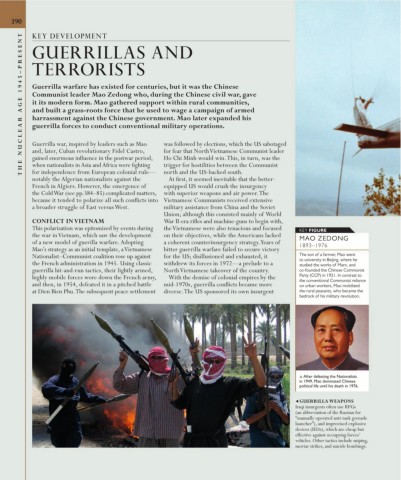
                                                                                                            ▲ After defeating the Nationalists
                                                                                                            in 1949, Mao dominated Chinese
                                                                                                            political life until his death in 1976.

                                                                                                          ◀ GUERRILLA WEAPONS
                                                                                                          Iraqi insurgents often use RPGs
                                                                                                          (an abbreviation of the Russian for
                                                                                                          “manually operated anti-tank grenade
                                                                                                          launcher”), and improvised explosive
                                                                                                          devices (IEDs), which are cheap but
                                                                                                          effective against occupying forces’
                                                                                                          vehicles. Other tactics include sniping,
                                                                                                          mortar strikes, and suicide bombings.

