


Page 387 - (DK) Smithsinian - Military History: The Definitive Visual Guide to the Objects of Warfare
P. 387
385


            “Mankind must put an end to war or war will put

            an end to mankind”                                                                                                          THE COLD  W


                                                        US PRESIDENT JOHN F. KENNEDY, SEPTEMBER 25, 1961

            centers deep within the territory of any potential   operate in a radiation-contaminated atmosphere. In
            enemy. Further refinements included the use    an attempt to ensure the continuity of government
            of multiple warheads on a single missile, and   in the event of nuclear onslaught, extensive                                AR ERA
            submarines that were able to fire nuclear weapons  underground bunkers were constructed to shelter
            while hidden underwater.                       officials at the onset of war.
              The US, exploiting its technical superiority
            over the Soviet Union, made repeated attempts    NUCLEAR DEADLOCK
            to construct missile-launched anti-ballistic-missile   In terms of civilian casualties, however, it was
            systems, of which the space-based “Star Wars”   clear that hundreds of millions of people on both
            defense was the most ambitious. None, however,   sides would be killed if a full nuclear exchange
            were successful. Meanwhile, some soldiers were   took place, and that life for those who did survive
            equipped with NBC (Nuclear, Biological, Chemical)  might well be unendurable. Thus,US military policy
            suits to help those who survived an initial blast to   during the 1960s was driven by the doctrine of
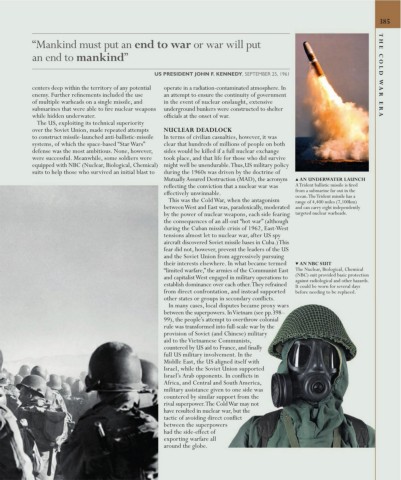
                                                           Mutually Assured Destruction (MAD), the acronym   ▲ AN UNDERWATER LAUNCH
                                                           reflecting the conviction that a nuclear war was   A Trident ballistic missile is fired
                                                           effectively unwinnable.                        from a submarine far out in the
                                                                                                          ocean. The Trident missile has a
                                                             This was the Cold War, when the antagonism   range of 4,400 miles (7,100km)
                                                           between West and East was, paradoxically, moderated   and can carry eight independently
                                                           by the power of nuclear weapons, each side fearing   targeted nuclear warheads.
                                                           the consequences of an all-out “hot war” (although
                                                           during the Cuban missile crisis of 1962, East-West
                                                           tensions almost let to nuclear war, after US spy
                                                           aircraft discovered Soviet missile bases in Cuba.) This
                                                           fear did not, however, prevent the leaders of the US
                                                           and the Soviet Union from aggressively pursuing
                                                           their interests elsewhere. In what became termed   ▼ AN NBC SUIT
                                                           “limited warfare,” the armies of the Communist East   The Nuclear, Biological, Chemical
                                                           and capitalist West engaged in military operations to   (NBC) suit provided basic protection
                                                                                                          against radiological and other hazards.
                                                           establish dominance over each other. They refrained   It could be worn for several days
                                                           from direct confrontation, and instead supported   before needing to be replaced.
                                                           other states or groups in secondary conflicts.
                                                             In many cases, local disputes became proxy wars
                                                           between the superpowers. In Vietnam (see pp.398–
                                                           99), the people’s attempt to overthrow colonial
                                                           rule was transformed into full-scale war by the
                                                           provision of Soviet (and Chinese) military
                                                           aid to the Vietnamese Communists,
                                                           countered by US aid to France, and finally
                                                           full US military involvement. In the
                                                           Middle East, the US aligned itself with
                                                           Israel, while the Soviet Union supported
                                                           Israel’s Arab opponents. In conflicts in
                                                           Africa, and Central and South America,
                                                           military assistance given to one side was
                                                           countered by similar support from the
                                                           rival superpower. The Cold War may not
                                                           have resulted in nuclear war, but the
                                                           tactic of avoiding direct conflict
                                                           between the superpowers
                                                           had the side-effect of
                                                           exporting warfare all
                                                           around the globe.

