


Page 390 - (DK) Smithsinian - Military History: The Definitive Visual Guide to the Objects of Warfare
P. 390
388    NUCLEAR ATTACK SUBMARINE                                                                 Bridge   Sail             Propeller

         GE 1945–PRESENT  USS NAUTILUS                                                         Torpedo tube doors  Sail Flat deck area


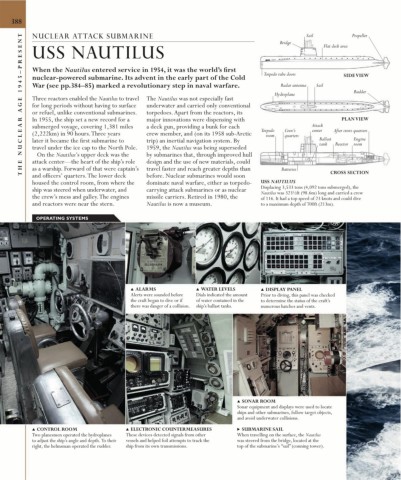
            When the Nautilus entered service in 1954, it was the world’s first
                                                                                                                            SIDE VIEW
            nuclear-powered submarine. Its advent in the early part of the Cold
            War (see pp.384–85) marked a revolutionary step in naval warfare.
                                                                                                     Radar antenna
                                                                                                                               Rudder

            for long periods without having to surface
                                                     underwater and carried only conventional
         A  Three reactors enabled the Nautilus to travel  The Nautilus was not especially fast    Hydroplane   Attack     PLAN VIEW
                                                     torpedoes. Apart from the reactors, its
            or refuel, unlike conventional submarines.
         THE NUCLEAR   (2,222km) in 90 hours. Three years    crew member, and (on its 1958 sub-Arctic   Torpedo   Crew’s   center  After crews quarters
            In 1955, the ship set a new record for a
                                                     major innovations were dispensing with
            submerged voyage, covering 1,381 miles
                                                     a deck gun, providing a bunk for each
                                                                                                room
                                                                                                      quarters
                                                                                                                   Ballast
                                                                                                                               Engine
            later it became the first submarine to
                                                     trip) an inertial navigation system. By
                                                                                                                         Reactor
                                                                                                                   tank
                                                                                                                               room
            travel under the ice cap to the North Pole.
                                                     1959, the Nautilus was being superseded
                                                     by submarines that, through improved hull
              On the Nautilus’s upper deck was the
            attack center—the heart of the ship’s role
                                                     design and the use of new materials, could
            as a warship. Forward of that were captain’s  travel faster and reach greater depths than
                                                                                                     Batteries
            and officers’ quarters. The lower deck
                                                     dominate naval warfare, either as torpedo-
            housed the control room, from where the   before. Nuclear submarines would soon   USS NAUTILUS             CROSS SECTION
            ship was steered when underwater, and    carrying attack submarines or as nuclear   Displacing 3,533 tons (4,092 tons submerged), the
                                                                                              Nautilus was 323½ft (98.6m) long and carried a crew
            the crew’s mess and galley. The engines    missile carriers. Retired in 1980, the   of 116. It had a top speed of 23 knots and could dive
            and reactors were near the stern.        Nautilus is now a museum.                to a maximum depth of 700ft (213m).
              OPERATING SYSTEMS


                                               ▲ ALARMS                ▲ WATER LEVELS         ▲ DISPLAY PANEL
                                               Alerts were sounded before    Dials indicated the amount    Prior to diving, this panel was checked
                                               the craft began to dive or if   of water contained in the   to determine the status of the craft’s
                                               there was danger of a collision.  ship’s ballast tanks.  numerous hatches and vents.


                                                                                      ▲ SONAR ROOM
                                                                                      Sonar equipment and displays were used to locate
                                                                                      ships and other submarines, follow target objects,
                                                                                      and avoid underwater collisions.

            ▲ CONTROL ROOM                    ▲ ELECTRONIC COUNTERMEASURES           ▶ SUBMARINE SAIL
            Two planesmen operated the hydroplanes    These devices detected signals from other    When travelling on the surface, the Nautilus
            to adjust the ship’s angle and depth.  To their   vessels and helped foil attempts to track the    was steered from the bridge, located at the
            right, the helmsman operated the rudder.  ship from its own transmissions.  top of the submarine’s  “sail” (conning tower).

