


Page 388 - (DK) Smithsinian - Military History: The Definitive Visual Guide to the Objects of Warfare
P. 388
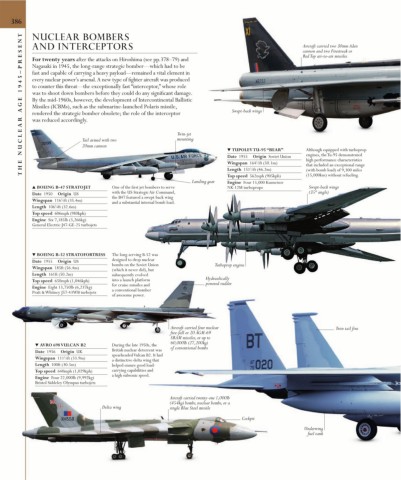
386    NUCLEAR BOMBERS                                                                                  Aircraft carried two 30mm Aden

         GE 1945–PRESENT  For twenty years after the attacks on Hiroshima (see pp.378–79) and                cannon and two Firestreak or
            AND INTERCEPTORS

                                                                                                             Red Top air-to-air missiles
            Nagasaki in 1945, the long-range strategic bomber—which had to be
            fast and capable of carrying a heavy payload—remained a vital element in
            every nuclear power’s arsenal. A new type of fighter aircraft was produced
            to counter this threat—the exceptionally fast “interceptor,” whose role


            By the mid-1960s, however, the development of Intercontinental Ballistic
            Missiles (ICBMs), such as the submarine-launched Polaris missile,
         A  was to shoot down bombers before they could do any significant damage.   Swept-back wings
            rendered the strategic bomber obsolete; the role of the interceptor
         THE NUCLEAR          Tail armed with two               Twin-jet          ▼ TUPOLEV TU-95 “BEAR”      Although equipped with turboprop
            was reduced accordingly.

                                                                mounting
                              20mm cannon
                                                                                                              engines, the Tu-95 demonstrated
                                                                                  Date  1955     Origin  Soviet Union
                                                                                                              high performance characteristics
                                                                                            1
                                                                                  Wingspan  164 ⁄2ft (50.1m)
                                                                                          1
                                                                                  Length  151 ⁄2ft (46.2m)
                                                                                                              (with bomb load) of 9,300 miles
                                                                                                              (15,000km) without refueling.
                                                                                  Top speed  562mph (905kph)  that included an exceptional range
                                                                     Landing gear  Engine  Four 15,000 Kuznetsov
            ▲ BOEING B-47 STRATOJET      One of the first jet bombers to serve    NK-12M turboprops            Swept-back wings
            Date  1950     Origin  US    with the US Strategic Air Command,                                    (350 angle)
                                         the B47 featured a swept-back wing
                       1
            Wingspan  116 ⁄4ft (35.4m)
                                         and a substantial internal bomb load.
                    3
            Length  106 ⁄4ft (32.6m)
            Top speed  606mph (980kph)
            Engine  Six 7,185lb (3,266kg)
            General Electric J47-GE-25 turbojets
            ▼ BOEING B-52 STRATOFORTRESS  The long-serving B-52 was
            Date  1955     Origin  US    designed to drop nuclear
                                         bombs on the Soviet Union           Turboprop engine
            Wingspan  185ft (56.4m)
                                         (which it never did), but
            Length  161ft (50.2m)        subsequently evolved
            Top speed  650mph (1,046kph)  into a launch platform          Hydraulically
                                         for cruise missiles and          powered rudder
            Engine  Eight 13,750lb (6,237kg)
            Pratt & Whitney J57-43WB turbojets  a conventional bomber
                                         of awesome power.


                                                              Aircraft carried four nuclear                              Twin tail fins
                                                              free-fall or 20 AGM-69
                                                              SRAM missiles, or up to
                                                              60,000lb (27,200kg)
             ▼ AVRO 698 VULCAN B2        During the late 1950s, the   of conventional bombs
             Date  1956     Origin  UK   British nuclear deterrent was
                                         spearheaded Vulcan B2. It had
             Wingspan  111 ⁄4ft (33.9m)
                        1
                                         a distinctive delta wing that
             Length  100ft (30.5m)       helped ensure good load-
             Top speed  640mph (1,029kph)  carrying capabilities and
                                         a high subsonic speed.
             Engine  Four 22,000lb (9,992kg)
             Bristol Siddeley Olympus turbojets
                                                             Aircraft carried twenty-one 1,000lb
                                                             (454kg) bombs, nuclear bombs, or a
                                     Delta wing              single Blue Steel missile

                                                                                       Cockpit
                                                                                                             Underwing
                                                                                                               fuel tank

