


Page 84 - (DK) Smithsinian - Military History: The Definitive Visual Guide to the Objects of Warfare
P. 84
82    KEY DEVELOPMENT                                                                                 KEY BATTLE

         WMEN 500–1500  SIEGES AND THE                                                                      THE SIEGE OF


                                                                                                            ROUEN
                                                                                                            1418–19
            ART OF FORTIFICATION
                                                                                                            In July 1418, the city of Rouen, in
                                                                                                            France, was beseiged by an English
                                                                                                            army under King Henry V. French
                                                                                                            crossbowmen held the attackers at
            Castles and siege warfare flourished in the medieval period, mainly as a result
                                                                                                            bay, while primitive English cannon
                                                                                                            well-built masonry. After six months
            technology of siege weapons and tactics evolved, it drove developments
         AND BO  of widespread insecurity and the fragmentation of political power. As the                  failed to batter a breach in the
                                                                                                            of tight blockade, the defenders
            in the design of castles and city walls.
                                                                                                            were starved into submission.
            In the 11th century, most castles in western Europe
                                                           mangonels and trebuchets failed to make a breach
            were still made of wood and earth. When the first
                                                           in the walls, these could be attacked with rams, or
         KNIGHTS   crusader armies from the west made their way to   by tunnelling to undermine the foundations. A
            the Holy Land in 1096–99, they were awed by the
                                                           portable roof—the cat—was deployed to protect
            defensive structures they found—massive stone
                                                           troops against missiles from above as they advanced
                                                           to bring forward a ram, or hack at the wall with
            fortifications ringed the great cities around the
                                                           picks. Occasionally an assault on unbreached walls
            eastern Mediterranean, such as Constantinople
            and Jerusalem. During the following century, stone  succeeded, either by scaling ladders or by rolling
            castles were to become the norm across western   a tall wooden siege tower
            Europe, as well as in the crusader states in the    forward. More often,
                                                                                                            ▲ Painted in around 1480, this French
            east. At first these were mostly quite simple, with    a weak point such as                     image of the siege shows the attackers
            a tall curtain wall surrounding an elevated stone   an unlocked door was                        attempting to breach the city walls
                                                                                                            with their guns.
            keep. This posed sufficient problems for besieging   discovered—or the
            forces equipped with mangonels—stone-throwing   defenders were betrayed
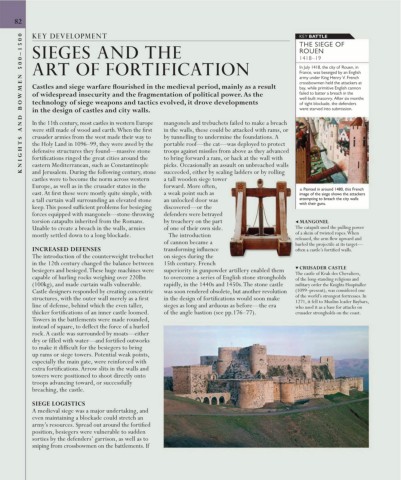
            torsion catapults inherited from the Romans.   by treachery on the part                       ◀ MANGONEL
            Unable to create a breach in the walls, armies   of one of their own side.                    The catapult used the pulling power
            mostly settled down to a long blockade.          The introduction                             of a skein of twisted ropes. When
                                                           of cannon became a                             released, the arm flew upward and
                                                                                                          hurled the projectile at its target—
            INCREASED DEFENSES                             transforming influence                         often a castle’s fortified walls.
            The introduction of the counterweight trebuchet   on sieges during the
            in the 12th century changed the balance between   15th century. French
            besiegers and besieged. These huge machines were   superiority in gunpowder artillery enabled them    ▼ CRUSADER CASTLE
            capable of hurling rocks weighing over 220lbs   to overcome a series of English stone strongholds   The castle of Krak des Chevaliers,
                                                                                                          of the long-standing religious and
            (100kg), and made curtain walls vulnerable.    rapidly, in the 1440s and 1450s. The stone castle   military order the Knights Hospitaller
            Castle designers responded by creating concentric   was soon rendered obsolete, but another revolution   (1099–present), was considered one
            structures, with the outer wall merely as a first   in the design of fortifications would soon make   of the world’s strongest fortresses. In
            line of defense, behind which the even taller,   sieges as long and arduous as before—the era    1271, it fell to Muslim leader Baybars,
                                                                                                          who used it as a base for attacks on
            thicker fortifications of an inner castle loomed.   of the angle bastion (see pp.176–77).     crusader strongholds on the coast.
            Towers in the battlements were made rounded,
            instead of square, to deflect the force of a hurled
            rock. A castle was surrounded by moats—either
            dry or filled with water—and fortified outworks
            to make it difficult for the besiegers to bring
            up rams or siege towers. Potential weak points,
            especially the main gate, were reinforced with
            extra fortifications. Arrow slits in the walls and
            towers were positioned to shoot directly onto
            troops advancing toward, or successfully
            breaching, the castle.

            SIEGE LOGISTICS
            A medieval siege was a major undertaking, and
            even maintaining a blockade could stretch an
            army’s resources. Spread out around the fortified
            position, besiegers were vulnerable to sudden
            sorties by the defenders’ garrison, as well as to
            sniping from crossbowmen on the battlements. If

