


Page 86 - (DK) Smithsinian - Military History: The Definitive Visual Guide to the Objects of Warfare
P. 86
84    MEDIEVAL FORTIFICATION                                                            Rear gatehouse             Kitchen

         WMEN 500–1500  BODIAM CASTLE                                                        Square side        Courtyard


                                                                                              Round corner
                                                                                                   tower
                                                                                                                 Great hall
            Europe’s larger medieval castles were military strongholds and
            centers of administration. Smaller castles, such as Bodiam in southern
                                                                                                 tower
            England, were the homes of wealthy knights, built in martial styles.


         AND BO  Early European castles were built of wood   A castle was a statement of the owner’s   Chapel Drawbridge  Front gatehouse
            and earth. With the adoption of stone as a
                                                     wealth, power, and prestige, but it was
                                                     also skillfully designed to give its occupants
            construction material in the 11th century,
            castles became more expensive to build,
                                                     the best chance of fending off an enemy. Its
            but also longer lasting and more immune
                                                     walls and towers thus had to be resistant to
                                                                                                        Barbican
            to fire and rot. The first stone castles had
                                                     stone-throwing siege engines and difficult
         KNIGHTS   a central tower, or “keep,” encircled by a   for tunnel-digging engineers to undermine.   CASTLE LAYOUT  Outwork
                                                                                                    Causeway
                                                     However, the increasing use of gunpowder
            defensive wall. By the time Sir Edward
                                                                                                                           PLAN VIEW
            Dallingridge built Bodiam in 1385, towers
                                                     and cannon in the 15th century eventually
            had been integrated into the walls and the
                                                     made the stone walls of the medieval castle
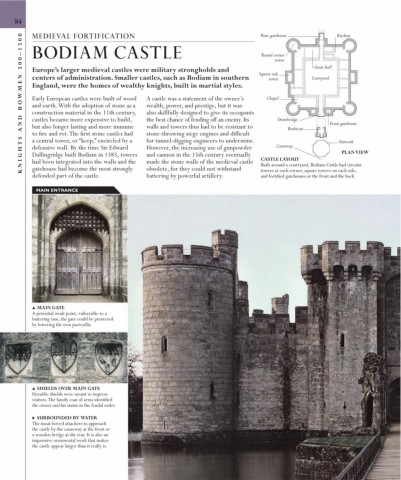
                                                                                              Built around a courtyard, Bodiam Castle had circular
            gatehouse had become the most strongly
            defended part of the castle.             obsolete, for they could not withstand   towers at each corner, square towers on each side,
                                                     battering by powerful artillery.
                                                                                              and fortified gatehouses at the front and the back.
              MAIN ENTRANCE


            ▲ MAIN GATE
            A potential weak point, vulnerable to a
            battering ram, the gate could be protected
            by lowering the iron portcullis.


            ▲ SHIELDS OVER MAIN GATE
            Heraldic shields were meant to impress
            visitors. The family coat of arms identified
            the owner and his status in the feudal order.
            ▶ SURROUNDED BY  WATER
            The moat forced attackers to approach
            the castle by the causeway at the front or
            a wooden bridge at the rear. It is also an
            impressive ornamental work that makes
            the castle appear larger than it really is.

