


Page 88 - (DK) Smithsinian - Military History: The Definitive Visual Guide to the Objects of Warfare
P. 88
86      KEY EVENTS                 KEY DEVELOPMENT

         WMEN 500–1500  11th–15th century  GUNPOWDER


              ◼ 1044  A document written for the
              Chinese emperor describes the use
                                         MAKES ITS MARK
              of gunpowder for smoke bombs and
              incendiary devices in sieges.
              ◼ 1231  “Fire lances”—primitive
                                         The arrival of gunpowder is often dated to 1453, when the massive cannon of
              flamethrowers—and “thunder-crash
              bombs” are employed in the defense
                                         sieges for a thousand years. However, by this time, gunpowder had already been
              Mongols’ forces.
         AND BO  of Kaifeng (Beijing) against the   Sultan Mehmed II breeched the walls of Constantinople, a city that had resisted
                                         in military use in China for four centuries.
              ◼ 1326  The government of
              Florence, Italy, orders a supply of
                                         The explosive properties of a mix of charcoal,
              metal cannon and ammunition to
                                                                                        together with iron hoops. Exploiting the propulsive
              be used in the defense of the city.
                                         sulfur, and saltpeter were probably discovered
                                                                                        power of improved “corned” gunpowder, these
         KNIGHTS   ◼ 1346  King Edward III of England  by Chinese alchemists during the Tang dynasty   mighty but cumbersome cannon were capable of
                                                                                        hurling stone shot with crushing force against the
                                         (618–907ce). Documents from the Song dynasty,
              uses small field cannon against the
              French, at the Battle of Crécy.
                                         in the 11th century, make reference to the use of
                                                                                        walls of large structures, such as castles and towns,
                                                                                        facilitating early siege warfare. The artillery used at
                                         gunpowder-tipped arrows as incendiary devices,
              ◼ c.1350  Chinese armies are
              regularly deploying hundreds of
              cannon and primitive handguns
                                                                                        Ottoman Sultan Mehmed by a renegade Christian
                                         into besieged cities by catapult.
              in field battles and sieges.  and of gunpowder fire-bombs that were hurled   the 1453 Siege of Constantinople, made for
                                          Over the following centuries, a whole family    Hungarian artillery expert, included a bombard so
              ◼ 1380s  Large siege guns   of gunpowder weapons was developed, from      large that it traveled on a cart drawn by 50 yoke of
              (bombards) come into use in   flame-throwing “fire-lances” to grenades, rockets,   oxen and could fire a ball weighing up to half a ton.
              Europe; some are capable of
              firing stone shot weighing up    hand-held guns, and primitive cannon. These   For a brief period of time, heavy cannon were
              to 500lb (230kg).          devices did not transform the Chinese practice    decisive weapons. At the same time that Mehmed
                                         of war, but took their place as a significant but   was taking Constantinople, the French royal
              ◼ 1421  Using hand guns and
              cannon mounted on wagons,   subsidiary adjunct to traditional weaponry, often   artillery, created by brothers Jean and Gaspard
              Hussites led by Jan Zizka defeat   employed primarily for psychological effect.   Bureau, was making a decisive contribution to the
              Sigismund, King of Hungary                                                defeat of the English at the end of the Hundred
              and Bohemia, at the Battle of
              Kutna Hora.                THE NEW TECHNOLOGY
                                         As the new gunpowder-based technology filtered
              ◼ 1439–53  Brothers Jean   through to the Muslim armies of West Asia and to
              and Gaspard Bureau create a
              powerful artillery train for King    Christian Europe, in the 12th and 13th
              Charles VII of France, aiding him      centuries, its impact at first remained
              in the defeat of the English in the    marginal. The few small cannon
              Hundred Years’ War.
                                                     deployed at Crécy in 1346 were
              ◼ 1453  Sultan Mehmed II of the          puny in their effect compared with
              Ottomans uses large cannon to            the decisive firepower of the
              decisive effect during the successful
              siege of Constantinople.                             archers’ longbows.
                                                                    However, European
                                                                    military artisans
                                                                    and their employers
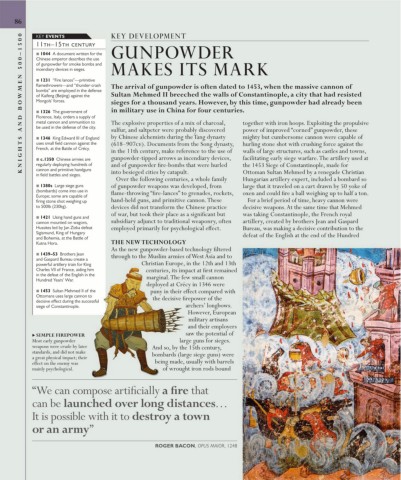
            ▶ SIMPLE FIREPOWER                                     saw the potential of
            Most early gunpowder                                 large guns for sieges.
            weapons were crude by later                And so, by the 15th century,
            standards, and did not make                bombards (large siege guns) were
            a great physical impact; their
            effect on the enemy was                     being made, usually with barrels
            mainly psychological.                          of wrought iron rods bound

            “We can compose artificially a fire that
            can be launched over long distances…

            It is possible with it to destroy a town

            or an army”


                                                        ROGER BACON, OPUS MAIOR, 1248

