


Page 83 - (DK) Smithsinian - Military History: The Definitive Visual Guide to the Objects of Warfare
P. 83
81

                                                               MEDIEVAL KNIGHTS AND BOWMEN
                                                               THE BATTLE                                                               THE BA


                                                               OF CRÉCY


                                                               During the Hundred Years’  War—the series of conflicts fought
                                                               between the kings of France and England from 1337 to 1453—               TTLE OF CRÉCY
                                                               the medieval knight’s dominance of the European battlefield
                                                               began to wane. At Crécy in 1346, mounted armored warriors
                                                               were shot down by common bowmen.


                                                               In medieval Europe, knights and     According to chronicler Jean Froissart:
                                                               men-at-arms were a social and       “The English archers advanced one
                                                               military elite, traditionally accorded   step forward, and shot their arrows
                                                               pride of place on the battlefield.   with such force and quickness, that
                                                               Battles were supposed to be won by   it seemed as if it snowed.”
                                                               thundering charges in which nobles    Overwhelmed by the mass of
                                                               showed their prowess at fighting on   arrows, the Genoese fell back. But
                                                               horseback. In the course of wars with  discipline on the French side was
                                                               the Scots in the early 14th century,   poor. Their high-spirited noblemen
                                                               however, the English had learned the   considered themselves the finest
                                                               effectiveness of a different set of   knights in Europe, and they were
                                                               tactics. With knights and men-at-   more concerned with seeking personal
                                                               arms deployed on foot in a primarily   glory than obeying their king’s
                                                               defensive role, they used massed    commands. Not waiting for orders,
                                                               archers equipped with fast-shooting   they began a piecemeal charge
                                                               longbows to wreak havoc.            through the ranks of the fleeing
                                                                                                   Genoese. As the knights lumbered
                                                               LONGBOW IN THE ASCENDANT            uphill, the longbow arrows brought
                                                               In 1346, King Edward III of England   down horses and men, reducing the
                                                               landed in France with some 7,000    charge to floundering chaos. The
                                                               longbowmen, about 4,000 mounted     firing of the handful of cannon was
                                                               knights and men-at-arms, and several  barely noticed amid the devastation
                                                               thousand assorted foot soldiers.    wrought by thousands of bowmen,
                                                               Edward also brought with him a few   each shooting at least five arrows a
                                                               small cannon, some of the earliest   minute. Edward’s infantry, armed with
                                                               gunpowder weapons to be used in     spears and knives, rushed forward to
                                                               Europe. The king of France, Philip VI,   finish off the unhorsed Frenchmen.
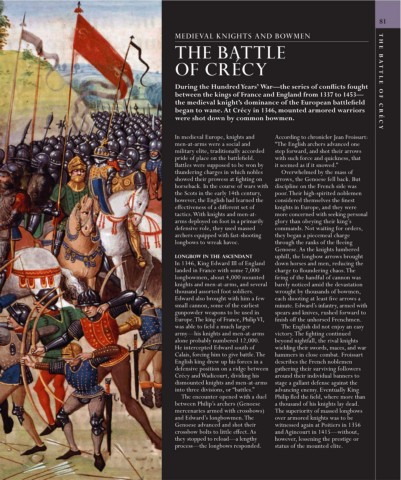
                                                               was able to field a much larger       The English did not enjoy an easy
                                                               army—his knights and men-at-arms    victory. The fighting continued
                                                               alone probably numbered 12,000.     beyond nightfall, the rival knights
                                                               He intercepted Edward south of      wielding their swords, maces, and war
                                                               Calais, forcing him to give battle. The   hammers in close combat. Froissart
                                                               English king drew up his forces in a   describes the French noblemen
                                                               defensive position on a ridge between  gathering their surviving followers
                                                               Crécy and Wadicourt, dividing his   around their individual banners to
                                                               dismounted knights and men-at-arms  stage a gallant defense against the
                                                               into three divisions, or “battles.”  advancing enemy. Eventually King
                                                                  The encounter opened with a duel   Philip fled the field, where more than
                                                               between Philip’s archers (Genoese   a thousand of his knights lay dead.
                                                               mercenaries armed with crossbows)   The superiority of massed longbows
                                                               and Edward’s longbowmen. The        over armored knights was to be
                                                               Genoese advanced and shot their     witnessed again at Poitiers in 1356
                                                               crossbow bolts to little effect. As    and Agincourt in 1415—without,
                                                               they stopped to reload—a lengthy    however, lessening the prestige or
                                                               process—the longbows responded.     status of the mounted elite.

