


Page 240 - (DK Eyewitness) Travel Guide - India
P. 240
238 CENTR AL INDIA
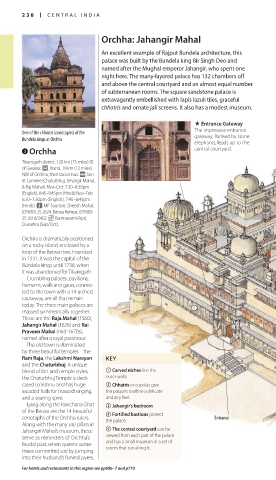
Orchha: Jahangir Mahal
An excellent example of Rajput Bundela architecture, this
palace was built by the Bundela king Bir Singh Deo and
named after the Mughal emperor Jahangir, who spent one
night here. The many-layered palace has 132 chambers off
and above the central courtyard and an almost equal number
of subterranean rooms. The square sandstone palace is
extravagantly embellished with lapis lazuli tiles, graceful
chhatris and ornate jali screens. It also has a modest museum.
. Entrance Gateway
One of the chhatris (cenotaphs) of the The impressive entrance
Bundela kings at Orchha gateway, flanked by stone
elephants, leads up to the
3 Orchha central courtyard.
Tikamgarh district. 120 km (75 miles) SE
of Gwalior. £ Jhansi, 19 km (12 miles)
NW of Orchha, then taxi or bus. @ Son
et Lumière (Chaturbhuj, Jehangir Mahal,
& Raj Mahal): Mar–Oct: 7:30–8:30pm
(English), 8:45–9:45pm (Hindi); Nov–Feb:
6:30–7:30pm (English), 7:45–8:45pm
(Hindi). n MP Tourism, Sheesh Mahal,
(07680) 25 2624; Betwa Retreat, (07680)
25 2618/2402. _ Ramnavami (Apr),
Dussehra (Sep/Oct).
Orchha is dramatically positioned
on a rocky island, enclosed by a
loop of the Betwa river. Founded
in 1531, it was the capital of the
Bundela kings until 1738, when
it was abandoned for Tikamgarh.
Crumbling palaces, pavilions,
hamams, walls and gates, con nec
ted to the town with a 14arched
causeway, are all that remain
today. The three main palaces are
massed symmetrically together.
These are the Raja Mahal (1560),
Jahangir Mahal (1626) and Rai
Praveen Mahal (mid1670s),
named after a royal paramour.
The old town is dominated
by three beautiful temples – the
Ram Raja, the Lakshmi Narayan KEY
and the Chaturbhuj. A unique
blend of fort and temple styles, 1 Carved niches line the
the Chaturbhuj Temple is dedi outer walls.
cated to Vishnu and has huge 2 Chhatris or cupolas give
arcaded halls for massed singing, the palace’s roofline a delicate
and a soaring spire. and airy feel.
Lying along the Kanchana Ghat 3 Jahangir’s bedroom
of the Betwa are the 14 beautiful
cenotaphs of the Orchha rulers. 4 Fortified bastions protect Entrance
the palace.
Along with the many sati pillars in
Jahangiri Mahal’s museum, these 5 The central courtyard can be
serve as reminders of Orchha’s viewed from each part of the palace
feudal past, when queens some and has a small museum in a set of
rooms that run along it.
times committed sati by jumping
into their husband’s funeral pyres.
For hotels and restaurants in this region see pp696–7 and p710
238-239_EW_India.indd 238 26/04/17 11:44 am
Eyewitness Travel LAYERS PRINTED:
Catalogue template “UK” LAYER
(Source v2.6)
Date 12th July 2013
Size 125mm x 217mm

