


Page 235 - (DK Eyewitness) Travel Guide - India
P. 235
M ADH Y A PR ADESH & CHHA T TISGARH 233
Exploring Gwalior Fort VISITORS’ CHECKLIST
Described by a 16th-century
Persian chronicler as “the pearl in Practical Information
the necklace of castles of Hind”, N of city centre.
Gwalior Fort has had a turbulent Open daily. & Son et Lumière:
history. Founded in the 8th Mar–Oct: 8:30pm daily; Nov–
century AD, it was successively Feb: 7:30pm daily. &
ruled by a series of local Hindu Archaeological Museum:
dynasties, followed by the Delhi Open 10am–5pm Sun–Thu.
Sultans, the Mughals and, finally, Closed Fri & public hols. &
the Maratha Scindias (see p475),
who became the maharajas of
Gwalior in the 18th century. Man Mandir Palace, its ornate
It was also briefly in pillars supporting a
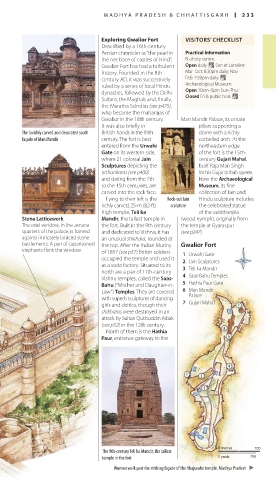
The lavishly carved and decorated south British hands in the 19th dome with a richly
façade of Man Mandir century. The fort is best corbelled arch. At the
entered from the Urwahi northeastern edge
Gate on its western side, of the fort is the 15th-
where 21 colossal Jain century Gujari Mahal,
Sculptures depicting the built Raja Man Singh
tirthankaras (see p400) for his Gujar (tribal) queen.
and dating from the 7th Now the Archaeological
to the 15th centuries, are Museum, its fine
carved into the rock face. collection of Jain and
Lying to their left is the Rock-cut Jain Hindu sculpture includes
richly carved, 25-m (82-ft) sculpture the cele brated statue
high temple, Teli ka of the salabhanjika
Stone Latticework Mandir, the tallest temple in (wood nymph), originally from
The oriel window, in the zenana the fort. Built in the 9th century the temple at Gyaraspur
quarters of the palace, is framed and dedicated to Vishnu, it has (see p247).
against intricately latticed stone an unusual shikhara, rounded at
battlements. A pair of caparisoned the top. After the Indian Mutiny Gwalior Fort
elephants flank the window. of 1857 (see p57) British soldiers 1 Urwahi Gate
occupied the temple and used it 2 Jain Sculptures
as a soda factory. Situated to its 3 Teli ka Mandir
north are a pair of 11th-century
Vishnu temples, called the Saas- 4 Saas-Bahu Temples
Bahu (“Mother and Daughter-in- 5 Hathia Paur Gate
Law”) Temples. They are covered 6 Man Mandir
with superb sculptures of dancing Palace
girls and deities, though their 7 Gujari Mahal
shikharas were destroyed in an
attack by Sultan Qutbuddin Aibak
(see p52) in the 12th century.
North of them is the Hathia
Paur, entrance gateway to the
0 metres 700
The 9th-century Teli ka Mandir, the tallest
temple in the fort 0 yards 700
Women walk past the striking façade of the Khajuraho temple, Madhya Pradesh
232-233_EW_India.indd 233 26/04/17 11:44 am

