


Page 239 - (DK Eyewitness) Travel Guide - India
P. 239
M ADH Y A PR ADESH & CHHA T TISGARH 237
several imposing Jain statues.
Most of the structures inside
the fort are attributed to Sultan
Mahmud of Malwa, and are
executed in the graceful provincial
Afghan style that distinguishes
the buildings of Mandu (see
pp251–3). The most ambitious
edifice here is the Koshak Mahal,
built in 1445. The sultan originally
planned it as a seven-storeyed
palace, but only managed to
complete two storeys, each with
balconies, rows of windows and
beautifully vaulted ceilings.
Other notable buildings are
The marble cenotaph of Madhavrao Scindia at Shivpuri the domed-and-arcaded Jama
Masjid and the Badal Mahal,
3 Orchha 5 Chanderi with its elegant gateway.
Chanderi was once a
See pp238–9. Guna district. 227 km (141 miles)
S of Gwalior. * 28,300. @ n MP flourishing centre of trade,
Tourism, Tanabana, (07547) 25 2222. and an exploration of the town
reveals large sandstone havelis,
4 Shivpuri The medieval town of Chanderi shops raised on plinths and
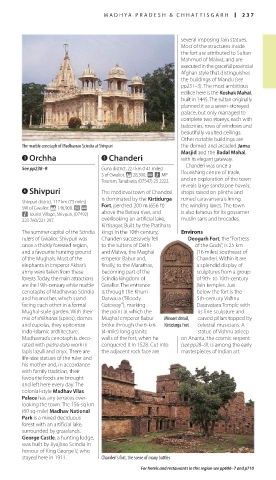
is dominated by the Kirtidurga ruined caravanserais lining
Shivpuri district. 117 km (73 miles)
SW of Gwalior. * 146,900. £ @ Fort, perched 200 m (656 ft) the winding lanes. The town
n Tourist Village, Shivpuri, (07492) above the Betwa river, and is also famous for its gossamer
223 760/221 297. overlooking an artificial lake, muslin saris and brocades.
Kirtisagar. Built by the Pratihara
The summer capital of the Scindia kings in the 10th century, Environs
rulers of Gwalior, Shivpuri was Chanderi successively fell Deogarh Fort, the “Fortress
once a thickly forested region, to the sultans of Delhi of the Gods”, is 25 km
and a favourite hunting ground and Malwa, the Mughal (16 miles) southeast of
of the Mughals. Most of the emperor Babur and, Chanderi. Within it are
elephants in Emperor Akbar’s finally, to the Marathas, a splendid display of
army were taken from these becoming part of the sculptures from a group
forests. Today, the main attractions Scindia kingdom of of 9th- to 10th-century
are the 19th-century white marble Gwalior. The entrance Jain temples. Just
cenotaphs of Madhavrao Scindia is through the Khuni below the fort is the
and his mother, which stand Darwaza (“Bloody 5th-century Vishnu
facing each other in a formal Gateway”), marking Dasavatara Temple with
Mughal-style garden. With their the point at which the its fine sculpture and
mix of shikharas (spires), domes Mughal emperor Babur Minaret detail, carved pillars topped by
and cupolas, they epitomize broke through the 6-km Kirtidurga Fort celestial musicians. A
Indo-Islamic architecture. (4-mile) long granite statue of Vishnu asleep
Madhavrao’s cenotaph is deco- walls of the fort, when he on Ananta, the cosmic serpent
rated with pietra dura work in conquered it in 1528. Cut into (see pp28–9), is among the early
lapis lazuli and onyx. There are the adjacent rock face are masterpieces of Indian art.
life-size statues of the ruler and
his mother and, in accordance
with family tradition, their
favourite foods are brought
and left here every day. The
colonial-style Madhav Vilas
Palace has airy terraces over-
looking the town. The 156-sq km
(60 sq-mile) Madhav National
Park is a mixed deciduous
forest with an artificial lake,
surrounded by grasslands.
George Castle, a hunting lodge,
was built by Jiyajirao Scindia in
honour of King George V, who
stayed here in 1911. Chanderi’s fort, the scene of many battles
For hotels and restaurants in this region see pp696–7 and p710
236-237_EW_India.indd 237 26/04/17 11:44 am

