


Page 298 - (DK Eyewitness) Travel Guide - India
P. 298
296 EASTERN INDIA
Ram Kinkar Baij (1910–80). The 8 Murshidabad
Vichitra Museum has memorabilia Murshidabad district. 200 km
from the poet’s life, including his (124 miles) N of Kolkata. £ @
paintings, developed from the
sketches he made in the margins The former capital of the nawabs
of his written work. Excellent of Bengal, Murshidabad lies in
performances of Rabindra Sangeet the green and gold Bengal
(songs written and set to music countryside. This city, on the
by Tagore) can be heard at the banks of the Bhagirathi river,
campus every evening. was founded in 1704 by Nawab
The village of Kenduli, nearby, Murshid Quli Khan, governor of
is the birthplace of the medieval the Mughal emperor Aurangzeb.
poet, Jayadeva, who composed His grave lies beneath the stairs
the Gita Govinda, a paean to of the impressive Katra Mosque,
Krishna. Every year in January built in 1724 along the lines
the Bauls, wandering minstrels of Kartalab Khan’s Mosque at
Students attending open-air classes at Visva known for their soulful songs, Dhaka. The nawab chose this
Bharati University gather here for Kendulimela, site because he wanted the
a festival where they sing without footsteps of the faithful to
7 Shantiniketan pause for three days. pass over him.
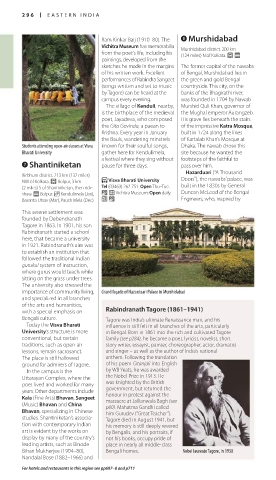
Hazarduari (“A Thousand
Birbhum district. 213 km (132 miles)
NW of Kolkata. £ Bolpur, 3 km P Visva Bharati University Doors”), the nawabs’ palace, was
(2 miles) S of Shantiniketan, then rick Tel (03463) 262 751. Open Thu–Tue. built in the 1830s by General
shaw. @ Bolpur. _ Kendulimela (Jan), & ^ Vichitra Museum: Open daily. Duncan McLeod of the Bengal
Basanta Utsav (Mar), Paush Mela (Dec). ^ & Engineers, who, inspired by
This serene settlement was
founded by Debendranath
Tagore in 1863. In 1901, his son
Rabindranath started a school
here, that became a university
in 1921. Rabindranath’s aim was
to establish an institution that
followed the traditional Indian
gurukul system of instruction,
where gurus would teach while
sitting on the grass under trees.
The university also stressed the
importance of community living, Grand façade of Hazarduari Palace in Murshidabad
and specialized in all branches
of the arts and humanities,
with a special emphasis on Rabindranath Tagore (1861–1941)
Bengali culture. Tagore was India’s ultimate Renaissance man, and his
Today the Visva Bharati influence is still felt in all branches of the arts, particularly
University’s structure is more in Bengal. Born in 1861 into the rich and cultivated Tagore
conventional, but certain family (see p284), he became a poet, lyricist, novelist, short
tradi tions, such as openair story writer, essayist, painter, choreographer, actor, dramatist
lessons, remain sacrosanct. and singer – as well as the author of India’s national
The place is still hallowed anthem. Following the translation
ground for admirers of Tagore. of his poem Gitanjali into English
In the campus is the by WB Yeats, he was awarded
Uttarayan Complex, where the the Nobel Prize in 1913. He
poet lived and worked for many was knighted by the British
years. Other departments include government, but returned the
honour in protest against the
Kala (Fine Arts) Bhavan, Sangeet massacre at Jallianwala Bagh (see
(Music) Bhavan and China p60). Mahatma Gandhi called
Bhavan, specializing in Chinese him Gurudev (“Great Teacher”).
studies. Shantiniketan’s associa Tagore died in August 1941, but
tion with contemporary Indian his memory is still deeply revered
art is evident by the works on by Bengalis, and his portraits, if
display by many of the country’s not his books, occupy pride of
leading artists, such as Binode place in nearly all middleclass
Bihari Mukherjee (1904–80), Bengali homes. Nobel laureate Tagore, in 1930
Nandalal Bose (1882–1966) and
For hotels and restaurants in this region see pp697–8 and p711
296-297_EW_India.indd 296 26/04/17 11:45 am
Eyewitness Travel LAYERS PRINTED:
Catalogue template “UK” LAYER
(Source v2.6)
Date 12th July 2013
Size 125mm x 217mm

