


Page 299 - (DK Eyewitness) Travel Guide - India
P. 299
WEST BENGAL & SIKKIM 297
Italian Baroque, gave it a banquet
hall lined with mirrors and a
striking circular Durbar Hall. The
palace is now a museum with
many fine exhibits, such as a
gigantic chandelier, presented
by Queen Victoria and hung
directly over the nawabs’ solid
silver throne. The library has
over 10,000 books, among
them some beautiful illuminated
Korans. Other items on display
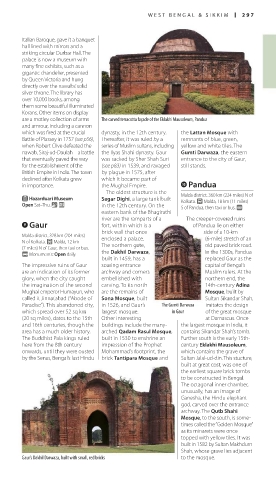
are a motley collection of arms The carved terracotta façade of the Eklakhi Mausoleum, Pandua
and armour, including a cannon
which was fired at the crucial dynasty, in the 12th century. the Lattan Mosque with
Battle of Plassey in 1757 (see p56), There after, it was ruled by a remnants of blue, green,
when Robert Clive defeated the series of Muslim sultans, including yellow and white tiles. The
nawab, Siraj-ud-Daulah – a battle the Ilyas Shahi dynasty. Gaur Gumti Darwaza, the eastern
that eventually paved the way was sacked by Sher Shah Suri entrance to the city of Gaur,
for the establishment of the (see p83) in 1539, and ravaged still stands.
British Empire in India. The town by plague in 1575, after
declined after Kolkata grew which it became part of
in importance. the Mughal Empire. 0 Pandua
The oldest structure is the Malda district. 360 km (224 miles) N of
E Hazarduari Museum Sagar Dighi, a large tank built Kolkata. £ Malda, 18 km (11 miles)
Open Sat–Thu. & ^ in the 12th century. On the S of Pandua, then taxi or bus. @
eastern bank of the Bhagirathi
river are the ramparts of a The creeper-covered ruins
9 Gaur fort, within which is a of Pandua lie on either
brick wall that once side of a 10-km
Malda district. 328 km (204 miles) enclosed a palace. (6-mile) stretch of an
N of Kolkata. £ Malda, 12 km
(7 miles) N of Gaur, then taxi or bus. The northern gate, old paved brick road.
@ Monuments: Open daily. the Dakhil Darwaza, In the 1300s, Pandua
built in 1459, has a replaced Gaur as the
The impressive ruins of Gaur soaring entrance capital of Bengal’s
are an indication of its former archway and corners Muslim rulers. At the
glory, when the city caught embellished with northern end, the
the imagination of the second carving. To its north 14th-century Adina
Mughal emperor Humayun, who are the remains of Mosque, built by
called it Jinnatabad (“Abode of Sona Mosque, built Sultan Sikandar Shah,
Paradise”). This abandoned city, in 1526, and Gaur’s The Gumti Darwaza imitates the design
which spread over 52 sq km largest mosque. in Gaur of the great mosque
(20 sq miles), dates to the 15th Other interesting at Damascus. Once
and 16th centuries, though the buildings include the many- the largest mosque in India, it
area has a much older history. arched Qadam Rasul Mosque, contains Sikandar Shah’s tomb.
The Buddhist Pala kings ruled built in 1530 to enshrine an Further south is the early 15th-
here from the 8th century impression of the Prophet century Eklakhi Mausoleum,
onwards, until they were ousted Mohammad’s footprint, the which contains the grave of
by the Senas, Bengal’s last Hindu brick Tantipara Mosque and Sultan Jalal-ud-din. This stucture,
built at great cost, was one of
the earliest square brick tombs
to be constructed in Bengal.
The octagonal inner chamber,
unusually, has an image of
Ganesha, the Hindu elephant
god, carved over the entrance
archway. The Qutb Shahi
Mosque, to the south, is some-
times called the “Golden Mosque”
as its minarets were once
topped with yellow tiles. It was
built in 1582 by Sultan Makhdum
Shah, whose grave lies adjacent
Gaur’s Dakhil Darwaza, built with small, red bricks to the mosque.
296-297_EW_India.indd 297 26/04/17 11:45 am

