


Page 351 - (DK Eyewitness) Travel Guide - India
P. 351
INTRODUCING WESTERN INDIA 349
on ancient feudal codes of conduct and
honour. As recently as 1987, an incident
of sati took place here, when a young
wid ow burnt herself on her husband’s
fun eral pyre, while the whole village
watch ed in admiration. But things are
changing: female literacy in Rajasthan,
which was just 20 per cent in the early
1990s has increased to over 67 per cent in
2013, and women now head many village
government councils. Rural development
schemes have brought schools, hospitals
and water to remote desert villages.
What has still not changed, however, is
the old-world courtesy and hospitality
encountered everywhere in Raja sthan,
be it in a princely palace or a mud hut
in the desert.
In sharp contrast with Rajasthan, Gujarat
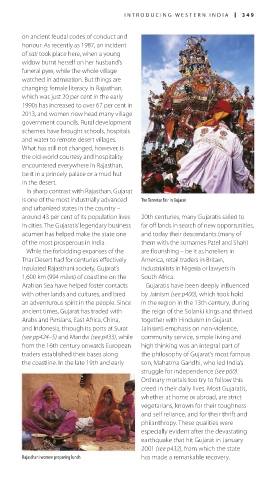
is one of the most industrially advanced The Tarnetar Fair in Gujarat
and urbanized states in the country –
around 43 per cent of its population lives 20th centuries, many Guj aratis sailed to
in cities. The Gujaratis’ legendary business far off lands in search of new opportunities,
acumen has helped make the state one and today their descendants (many of
of the most prosperous in India. them with the surnames Patel and Shah)
While the forbidding expanses of the are flourishing – be it as hoteliers in
Thar Desert had for centuries effectively America, retail traders in Britain,
insulated Rajasthani society, Gujarat’s industrialists in Nigeria or lawyers in
1,600 km (994 miles) of coastline on the South Africa.
Arabian Sea have helped foster contacts Gujaratis have been deeply influenced
with other lands and cultures, and bred by Jainism (see p400), which took hold
an adventurous spirit in the people. Since in the region in the 13th century, during
ancient times, Gujarat has traded with the reign of the Solanki kings and thrived
Arabs and Persians, East Africa, China, together with Hinduism in Gujarat.
and Indonesia, through its ports at Surat Jainism’s emphasis on non-violence,
(see pp424–5) and Mandvi (see p433), while community service, simple living and
from the 16th century onwards European high thinking was an integral part of
traders established their bases along the philosophy of Gujarat’s most famous
the coastline. In the late 19th and early son, Mahatma Gandhi, who led India’s
struggle for independence (see p60).
Ordinary mortals too try to follow this
creed in their daily lives. Most Gujaratis,
whether at home or abroad, are strict
vegetarians, known for their toughness
and self reliance, and for their thrift and
philanthropy. These qualities were
especially evident after the devastating
earthquake that hit Gujarat in January
2001 (see p432), from which the state
Rajasthani women preparing lunch has made a remarkable recovery.
348-349_EW_India.indd 349 26/04/17 11:46 am

