


Page 353 - (DK Eyewitness) Travel Guide - India
P. 353
INTRODUCING WESTERN INDIA 351
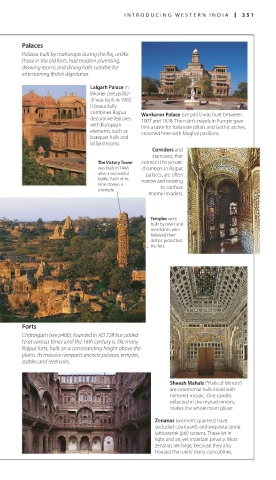
Palaces
Palaces built by maharajas during the Raj, unlike
those in the old forts, had modern plumbing,
drawing rooms and dining halls suitable for
entertaining British dignitaries.
Lalgarh Palace in
Bikaner (see pp382–
3) was built in 1902.
It beautifully
combines Rajput Wankaner Palace (see p431) was built between
decorative features 1907 and 1928. The ruler’s travels in Europe gave
with European him a taste for Italianate pillars and Gothic arches,
elements, such as crowned here with Mughal pavilions.
banquet halls and
billiard rooms.
Corridors and
staircases, that
The Victory Tower connect the private
was built in 1448 chambers in Rajput
after a successful palaces, are often
battle. Each of its narrow and twisting
nine storeys is
a temple. to confuse
enemy invaders.
Temples were
built by rulers and
merchants, who
believed their
deities protected
the fort.
Forts
Chittorgarh (see p406), founded in AD 728 but added
to at various times until the 16th century is, like many
Rajput forts, built on a commanding height above the
plains. Its massive ramparts encircle palaces, temples,
stables and reservoirs.
Sheesh Mahals (“Halls of Mirrors”)
are ceremonial halls inlaid with
mirrored mosaic. One candle,
reflected in the myriad mirrors,
makes the whole room glitter.
Zenanas (women’s quarters) have
secluded courtyards and exquisite stone
latticework (jali) screens. These let in
light and air, yet maintain privacy. Most
zenanas are large, because they also
housed the rulers’ many concubines.
350-351_EW_India.indd 351 26/04/17 11:54 am

