


Page 352 - (DK Eyewitness) Travel Guide - India
P. 352
350 WESTERN INDIA
Forts and Palaces
The spectacular forts of Rajasthan were originally
forbidding, defensive citadels, but by the mid-16th century,
when most Rajput states had made peace with the Mughals,
luxurious palaces, pleasure pavilions and gardens were
added to them, displaying many Mughal-inspired features.
In the late 19th and early 20th century there was another
spate of palace-building in both Rajasthan and Gujarat.
As a result of increasing contact between the British Raj
and the princely states, a marked European influence in
both architecture and decor is visible in these palaces.
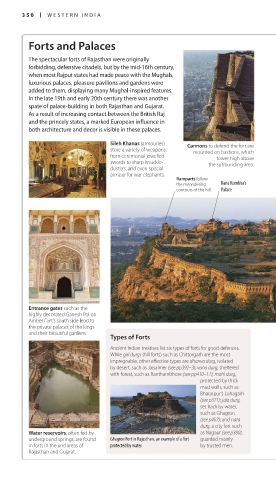
Sileh Khanas (armouries) Cannons to defend the fort are
store a variety of weapons, mounted on bastions, which
from ceremonial jewelled tower high above
swords to sharp knuckle- the surrounding area.
dusters, and even special
armour for war elephants.
Ramparts follow
the meandering Rana Kumbha’s
contours of the hill. Palace
Entrance gates such as the
highly decorated Ganesh Pol on
Amber Fort’s south side lead to
the private palaces of the kings
and their beautiful gardens.
Types of Forts
Ancient Indian treatises list six types of forts for good defences.
While giri durgs (hill forts) such as Chittorgarh are the most
impregnable, other effective types are dhanva durg, isolated
by desert, such as Jaisalmer (see pp392–3); vana durg, sheltered
with forest, such as Ranthambhore (see pp410–11); mahi durg,
protected by thick
mud walls, such as
Bharatpur’s Lohagarh
(see p371); jala durg,
set back by water,
such as Ghagron
(see p407); and nara
durg, a city fort such
Water reservoirs, often fed by as Nagaur (see p380),
underground springs, are found Ghagron Fort in Rajasthan, an example of a fort guarded mainly
in forts in the arid areas of protected by water by trusted men.
Rajasthan and Gujarat.
350-351_EW_India.indd 350 26/04/17 11:54 am

