


Page 408 - (DK Eyewitness) Travel Guide - India
P. 408
406 WESTERN INDIA
was by Sultan Alauddin Khilji (see
p52), whose goal was to capture
not only the fort but also the
queen, Rani Padmini, whose
legendary beauty the sultan had
glimpsed reflected in a mirror.
When defeat seemed inevitable,
Rani Padmini along with 13,000
women committed jauhar – a
ritual form of mass suicide by
immolation, practised by Rajput
women to escape dishonour at
the hands of their enemies. It is
said that 50,000 Rajput warriors
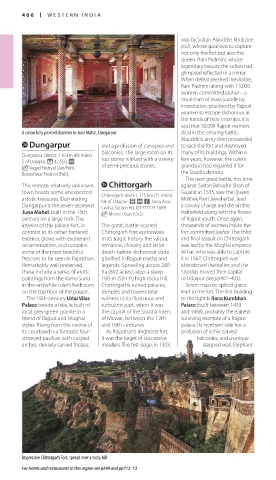
A colourfully painted chamber in Juna Mahal, Dungarpur died in the ensuing battle.
Alauddin’s army then proceeded
f Dungarpur and a profusion of canopies and to sack the fort and destroyed
balconies. The large room on its many of its buildings. Within a
Dungarpur district. 110 km (68 miles)
S of Udaipur. * 42,550. @ top storey is inlaid with a variety few years, however, the ruler’s
_ Vagad Festival (Jan/Feb), of semi-precious stones. grandson had regained it for
Baneshwar Festival (Feb). the Sisodia dynasty.
The next great battle, this time
This remote, relatively unknown g Chittorgarh against Sultan Bahadur Shah of
town boasts some unexpected Chittorgarh district. 115 km (71 miles) Gujarat in 1535, saw the Queen
artistic treasures. Dominating NE of Udaipur. £ @ n Janta Avas Mother, Rani Jawaharbai, lead
Dungarpur is the seven-storeyed Graha, Station Rd, (01472) 24 1089. a cavalry charge and die on the
Juna Mahal, built in the 13th _ Meera Utsav (Oct). battlefield along with the flower
century on a large rock. The of Rajput youth. Once again,
interior of this palace-fort, in The great, battle-scarred thousands of women inside the
contrast to its rather battered Chittorgarh Fort epitomizes fort committed jauhar. The third
exterior, glows with exuberant in its tragic history the valour, and final assault on Chittorgarh
ornamentation, and contains romance, chivalry and strict was led by the Mughal emperor
some of the most beautiful death-before-dishonour code Akbar, who was able to capture
frescoes to be seen in Rajasthan. glorified in Rajput myths and it in 1567. Chittorgarh was
Remarkably well preserved, legends. Sprawling across 280 abandoned thereafter, and the
these include a series of erotic ha (692 acres), atop a steep Sisodias moved their capital
paintings from the Kama Sutra 180-m (591-ft) high rocky hill, to Udaipur (see pp402–403).
in the erstwhile ruler’s bedroom, Chittorgarh’s ruined palaces, Seven massive spiked gates
on the top floor of the palace. temples and towers bear lead to the fort. The first building
The 19th-century Udai Vilas witness to its illustrious and to the right is Rana Kumbha’s
Palace beside a lake, is built of turbulent past, when it was Palace (built between 1433
local grey-green granite in a the capital of the Sisodia rulers and 1468), probably the earliest
blend of Rajput and Mughal of Mewar, between the 12th surviving example of a Rajput
styles. Rising from the centre of and 16th centuries. palace. Its northern side has a
its courtyard is a fantastic four- As Rajasthan’s mightiest fort, profusion of richly carved
storeyed pavilion with cusped it was the target of successive balconies, and a unique
arches, densely carved friezes, invaders. The first siege, in 1303, stepped wall. Elephant
Impressive Chittorgarh Fort, spread over a rocky hill
For hotels and restaurants in this region see p699 and pp712–13
406-407_EW_India.indd 406 26/04/17 11:46 am
Eyewitness Travel LAYERS PRINTED:
Catalogue template “UK” LAYER
(Source v2.6)
Date 12th July 2013
Size 125mm x 217mm

