


Page 409 - (DK Eyewitness) Travel Guide - India
P. 409
R A JASTHAN 407
stables and a council chamber j Kota
comprise its public areas, while Kota district. 261 km (162 miles) S of
the private apartments are a Jaipur. * 696,000. £ @ n Hotel
maze of small rooms, including Chambal, (0744) 232 6527. (
a zenana section. Near it are the _ Dussehra Mela (Sep/Oct).
20th-century Fateh Prakash
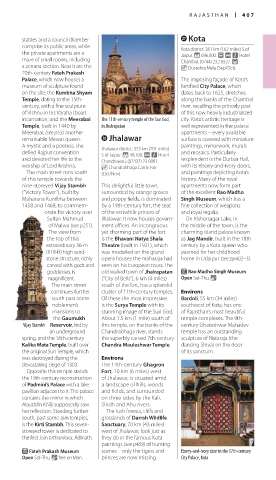
Palace, which now houses a The imposing façade of Kota’s
museum of sculpture found fortified City Palace, which
on the site; the Kumbha Shyam dates back to 1625, stretches
Temple, dating to the 15th- along the banks of the Chambal
cen tury, with a fine sculpture river, recalling the princely past
of Vishnu in his Varaha (boar) of this now heavily industrialized
incarnation; and the Meerabai The 11th-century temple of the Sun God, city. Kota’s artistic heritage is
Temple, built in 1440 by in Jhalrapatan well represented in the palace
Meerabai, (see p53) another apartments – every available
remarkable Mewar queen. h Jhalawar surface is covered with mini ature
A mystic and a poetess, she Jhalawar district. 323 km (201 miles) paintings, mirrorwork, murals
defied Rajput convention S of Jaipur. * 48,100. @ n Hotel and mosaics. Particularly
and devoted her life to the Chandrawati, (07432) 23 0081. resplendent is the Durbar Hall,
worship of Lord Krishna. _ Chandrabhaga Cattle Fair with its ebony-and-ivory doors,
The main street runs south (Oct/Nov). and paintings depicting Kota’s
of this temple towards the history. Many of the royal
nine-storeyed Vijay Stambh This delightful little town, apartments now form part
(“Victory Tower”), built by surrounded by orange groves of the excellent Rao Madho
Maharana Kumbha between and poppy fields, is dominated Singh Museum, which has a
1458 and 1468, to commem- by a 19th-century fort, the seat fine collection of wea pons
orate his victory over of the erstwhile princes of and royal regalia.
Sultan Mahmud Jhalawar. It now houses govern- On Kishorsagar Lake, in
of Malwa (see p251). ment offices. An incongruous the middle of the town, is the
The view from yet charming part of the fort charming island palace known
the top of this is the Bhavani Natya Shala as Jag Mandir, built in the 18th
extraordinary 36-m Theatre (built in 1921), which century by a Kota queen who
(118-ft) high sand- was modelled on the grand yearned for her childhood
stone structure, richly opera houses the maharaja had home in Udaipur (see pp402–5).
carved with gods and seen on his European tours. The
goddess es, is old walled town of Jhalrapatan E Rao Madho Singh Museum
magnificent. (“City of Bells”), 6 km (4 miles) Open Sat–Thu. &
The main street south of the fort, has a splendid
continues further cluster of 11th-century temples. Environs
south past some Of these the most impressive Bardoli, 55 km (34 miles)
noblemen’s is the Surya Temple with its southwest of Kota, has one
mansions to stunning image of the Sun God. of Rajasthan’s most beautiful
the Gaumukh About 1.5 km (1 mile) south of temple complexes. The 9th-
Vijay Stambh Reservoir, fed by this temple, on the banks of the century Ghateshwar Mahadev
an underground Chandrabhaga river, stands temple has an outstanding
spring, and the 16th-century the superbly carved 7th-century sculpture of Nataraja (the
Kalika Mata Temple, built over Chandra Mauleshwar Temple. dancing Shiva) on the door
the original Sun Temple, which of its sanctum.
was destroyed during the Environs
devastating siege of 1303. The 14th-century Ghagron
Opposite this temple stands Fort, 10 km (6 miles) west
the 19th-century reconstruction of Jhalawar, is situated amid
of Padmini’s Palace with a lake a landscape of hills, woods
pavilion adjacent to it. The palace and fields, and surrounded
contains the mirror in which on three sides by the Kali,
Alauddin Khilji supposedly saw Sindh and Ahu rivers.
her reflection. Standing further The lush forests, cliffs and
south, past some Jain temples, grasslands of Darrah Wildlife
is the Kirti Stambh. This seven- Sanctuary, 70 km (43 miles)
storeyed tower is dedicated to west of Jhalawar, look just as
the first Jain tirthankara, Adinath. they do in the famous Kota
paintings (see p409) of hunting
E Fateh Prakash Museum scenes – only the tigers and Ebony-and-ivory door in the 17th-century
Open Sat–Thu. & free on Mon. princes are now missing. City Palace, Kota
406-407_EW_India.indd 407 26/05/17 11:44 am

