


Page 485 - (DK Eyewitness) Travel Guide - India
P. 485
M AHAR ASHTR A 483
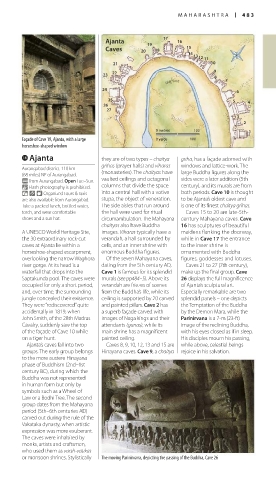
Ajanta 19 17 16
Caves 20 18 15
14
13 12 11
21 10
22 9
23
8
7
24
6
25 5 4
26
27
3
2
0 metres 100 1
Façade of Cave 19, Ajanta, with a large 0 yards 100
horseshoe-shaped window
r Ajanta they are of two types – chaitya griha, has a façade adorned with
grihas (prayer halls) and viharas windows and lattice-work. The
Aurangabad district. 110 km
(68 miles) NE of Aurangabad. (monas teries). The chaityas have large Buddha figures along the
@ from Aurangabad. Open Tue–Sun. vaulted ceilings and octagonal sides were a later addition (5th
& Flash photography is prohibited. columns that divide the space century), and its murals are from
= 0 8 Organized tours & taxis into a central hall with a votive both periods. Cave 10 is thought
are also available from Aurangabad. stupa, the object of veneration. to be Ajanta’s oldest cave and
Take a packed lunch, bottled water, The side aisles that run around is one of its finest chaitya grihas.
torch, and wear comfortable the hall were used for ritual Caves 15 to 20 are late-5th-
shoes and a sun hat. circumambulation. The Mahayana century Mahayana caves. Cave
chaityas also have Buddha 16 has sculptures of beautiful
A UNESCO World Heritage Site, images. Viharas typically have a maidens flanking the doorway,
the 30 extraordinary rock-cut verandah, a hall surrounded by while in Cave 17 the entrance
caves at Ajanta lie within a cells, and an inner shrine with to the inner shrine is
horseshoe-shaped escarpment, enormous Buddha figures. ornamented with Buddha
overlooking the narrow Waghora Of the seven Mahayana caves, figures, goddesses and lotuses.
river gorge. At its head is a dating from the 5th century AD, Caves 21 to 27 (7th century),
waterfall that drops into the Cave 1 is famous for its splendid make up the final group. Cave
Saptakunda pool. The caves were murals (see pp484–5). Above its 26 displays the full magnificence
occupied for only a short period, verandah are friezes of scenes of Ajanta’s sculptural art.
and, over time, the surrounding from the Buddha’s life, while its Especially remarkable are two
jungle concealed their existence. ceiling is supported by 20 carved splendid panels – one depicts
They were “rediscovered” quite and painted pillars. Cave 2 has the Temptation of the Buddha
accidentally in 1819, when a superb façade carved with by the Demon Mara, while the
John Smith, of the 28th Madras images of Naga kings and their Parinirvana is a 7-m (23-ft)
Cavalry, suddenly saw the top attendants (ganas), while its image of the reclining Buddha,
of the façade of Cave 10 while main shrine has a magnif icent with his eyes closed as if in sleep.
on a tiger hunt. painted ceiling. His disciples mourn his passing,
Ajanta’s caves fall into two Caves 8, 9, 10, 12, 13 and 15 are while above, celestial beings
groups. The early group belongs Hinayana caves. Cave 9, a chaitya rejoice in his salvation.
to the more austere Hinayana
phase of Buddhism (2nd–1st
century BC), during which the
Buddha was not represented
in human form but only by
symbols such as a Wheel of
Law or a Bodhi Tree. The second
group dates from the Mahayana
period (5th–6th centuries AD)
carved out during the rule of the
Vakataka dynasty, when artistic
expression was more exuberant.
The caves were inhabited by
monks, artists and craftsmen,
who used them as varsh-vatikas
or monsoon shrines. Stylistically The moving Parinirvana, depicting the passing of the Buddha, Cave 26
482-483_EW_India.indd 483 26/04/17 11:54 am

