


Page 486 - (DK Eyewitness) Travel Guide - India
P. 486
484 SOUTHWESTERN INDIA
The Ajanta Murals
The earliest and finest examples of Buddhist painting in
India can be seen at the Ajanta caves. Executed between
the 2nd century BC and the 5th century AD, the murals
show scenes from the Buddha’s life, and from the Jataka
Tales, which recount stories of the Buddha’s previous
incarnations as an enlightened being or Bodhisattva.
Magnificent, detailed compo sitions, the murals include
depictions of court scenes, princes and musicians, and
offer fascinating glimpses of daily life in the 5th century.
The colours, derived from plants and minerals, are in
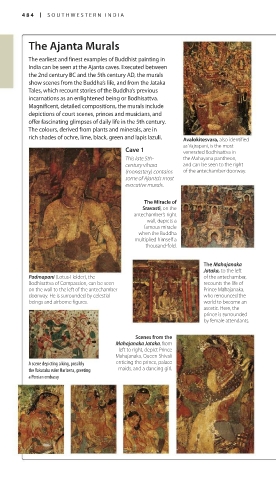
rich shades of ochre, lime, black, green and lapis lazuli. Avalokitesvara, also identified
as Vajrapani, is the most
Cave 1 venerated Bodhisattva in
This late 5th- the Mahayana pantheon,
century vihara and can be seen to the right
(monastery) contains of the antechamber doorway.
some of Ajanta’s most
evocative murals.
The Miracle of
Sravasti, on the
antechamber’s right
wall, depicts a
famous miracle
when the Buddha
multiplied himself a
thousand-fold.
The Mahajanaka
Jataka, to the left
Padmapani (Lotus-Holder), the of the antechamber,
Bodhisattva of Compassion, can be seen recounts the life of
on the wall to the left of the antechamber Prince Mahajanaka,
doorway. He is surrounded by celestial who renounced the
beings and airborne figures. world to become an
ascetic. Here, the
prince is surrounded
by female attendants.
Scenes from the
Mahajanaka Jataka, from
left to right, depict Prince
Mahajanaka, Queen Shivali
A scene depicting a king, possibly enticing the prince, palace
the Vakataka ruler Harisena, greeting maids, and a dancing girl.
a Persian embassy
484-485_EW_India.indd 484 26/04/17 11:47 am
Eyewitness Travel LAYERS PRINTED:
Feature template “UK” LAYER
(SourceReport v1.3)
Date 18th October 2012
Size 125mm x 217mm

