


Page 507 - (DK Eyewitness) Travel Guide - India
P. 507
G OA 505
image of Vishnu and a Surya and was developed during R Church of Our Lady
statue, dating to the Kadamba the reign of King Dom Manuel of the Rosary
period (11th–12th centuries), (r.1469–1521). A pair of Holy Hill. Open daily.
and stone inscriptions navigator’s globes With its castle-like turrets
in Marathi and Persian, and a Greek cross and simple altar painted with
relics of earlier ruling (the emblem of all baskets of flowers, this is one of
dynasties. Other Portuguese ships) Goa’s earliest Manueline-style
exhibits include Hindu embellish the door. churches. The tomb of Dona
sati stones, a model of The superb Baroque Catarina, wife of Garcia de Sá
São Gabriel (the ship interior has floral (viceroy from 1548-9) and the
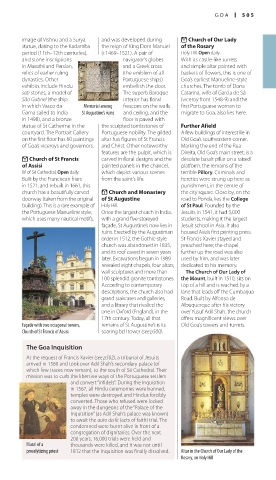
in which Vasco da Memorial among frescoes on the walls first Portuguese woman to
Gama sailed to India St Augustine’s ruins and ceiling, and the migrate to Goa, also lies here.
in 1498), and a bronze floor is paved with
statue of St Catherine in the the sculpted tombstones of Further Afield
courtyard. The Portrait Gallery Portuguese nobility. The gilded A few buildings of interest lie in
on the first floor has 60 paintings altar has figures of St Francis Old Goa’s southeastern corner.
of Goa’s viceroys and governors. and Christ. Other noteworthy Marking the end of the Rua
features are the pulpit, which is Direita, Old Goa’s main street, is a
R Church of St Francis carved in floral designs and the desolate basalt pil lar on a raised
of Assisi painted panels in the chancel, platform, the remains of the
W of Sé Cathedral. Open daily. which depict various scenes terrible Pillory. Criminals and
Built by the Franciscan friars from the saint’s life. heretics were strung up here as
in 1521, and rebuilt in 1661, this punishment, in the centre of
church has a beautifully carved R Church and Monastery the city square. Close by, on the
doorway (taken from the original of St Augustine road to Ponda, lies the College
building). This is a rare example of Holy Hill. of St Paul. Founded by the
the Portuguese Manueline style, Once the largest church in India, Jesuits in 1541, it had 3,000
which uses many nautical motifs, with a grand five-storeyed students, making it the largest
façade, St Augustine’s now lies in Jesuit school in Asia. It also
ruins. Erected by the Augustinian housed Asia’s first printing press.
order in 1512, the Gothic-style St Francis Xavier stayed and
church was abandoned in 1835, preached here; the chapel
and its roof caved in seven years further up the road was also
later. Excavations begun in 1989 used by him, and was later
revealed eight chapels, four altars, dedicated to his memory.
wall sculptures and more than The Church of Our Lady of
100 splendid granite tombstones. the Mount, built in 1510, sits on
According to contemporary top of a hill and is reached by a
descriptions, the church also had lane that leads off the Cumbarjua
grand staircases and galleries, Road. Built by Alfonso de
and a library that rivalled the Albuquerque after his victory
one in Oxford (England), in the over Yusuf Adil Shah, the church
17th century. Today, all that offers magnificent views over
Façade with two octagonal towers, remains of St Augustine’s is its Old Goa’s towers and turrets.
Church of St Francis of Assisi soaring bell tower (see p500).
The Goa Inquisition
At the request of Francis Xavier (see p502), a tribunal of Jesuits
arrived in 1560 and took over Adil Shah’s secondary palace (of
which few traces now remain), to the south of Sé Cathedral. Their
mission was to curb the libertine ways of the Portuguese settlers
and convert “infidels”. During the Inquisition
in 1567, all Hindu ceremonies were banned,
temples were destroyed and Hindus forcibly
converted. Those who refused were locked
away in the dungeons of the “Palace of the
Inquisition” (as Adil Shah’s palace was known)
to await the auto da fé (acts of faith) trial. The
condemned were burnt alive in front of a
congregation of dignitaries. Over the next
200 years, 16,000 trials were held and
Mural of a thousands were killed, and it was not until
prose lytizing priest 1812 that the Inquisition was finally dissolved. Altar in the Church of Our Lady of the
Rosary, on Holy Hill
504-505_EW_India.indd 505 26/04/17 11:48 am

