


Page 511 - (DK Eyewitness) Travel Guide - India
P. 511
G OA 509
Margao’s lively bazaars, selling
the day’s catch of fish and
fresh fruit and vegetables.
The Covered Market, close
by, sells just about everything,
including piles of soap flakes,
pulses, dried fish, pickles, spicy
pork sausages, tamarind,
flower garlands, jaggery and
crockery. A row of shops to
the north sells locally brewed
wines, and the lane just
outside the market has a
number of cloth merchants.
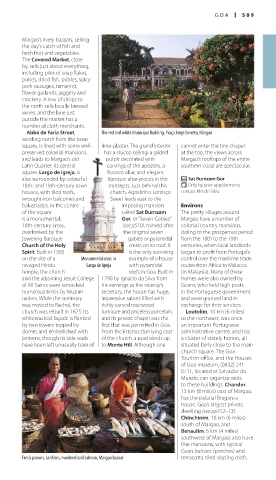
Abbé de Faria Street, The red and white Municipal Building, Praça Jorge Barreto, Margao
winding north from the town
square, is lined with some well- lime-plaster. The grand interior cannot enter the tiny chapel
preserved colonial mansions, has a stucco ceiling, a gilded at the top, the views across
and leads to Margao’s old pulpit decorated with Margao’s rooftops of the entire
Latin Quarter. Its central carvings of the apostles, a southern coast are spectacular.
square, Largo de Igreja, is Rococo altar, and elegant
also surrounded by colourful Baroque altar-pieces in the P Sat Burnzam Gor
18th- and 19th-century town transepts. Just behind this 8 Only by prior appointment;
houses, with tiled roofs, church, Agostinho Lorenço contact Mrs de Silva.
wrought-iron balconies and Street leads east to the
balustrades. In the centre imposing mansion Environs
of the square called Sat Burnzam The pretty villages around
is a monumental, Gor, or “Seven Gables” Margao have a number of
16th-century cross, (see p510), named after colonial country mansions,
overlooked by the the original seven dating to the prosperous period
towering Baroque gables or pyramidal from the 18th to the 19th
Church of the Holy crests on its roof. It centuries, when local landlords
Spirit. Built in 1565 is the only surviving began to profit from Portugal’s
on the site of a Monumental cross in example of a house control over the maritime trade
ravaged Hindu Largo de Igreja with pyramidal routes from Africa to Malacca
temple, the church roofs in Goa. Built in (in Malaysia). Many of these
and the adjoining Jesuit College 1790 by Ignacio da Silva from homes were also owned by
of All Saints were ransacked his earnings as the viceroy’s Goans, who held high posts
numerous times by Muslim sec retary, the house has huge, in the Portuguese government
raiders. While the seminary impressive salons filled with and were granted land in
was moved to Rachol, the richly carved rosewood exchange for their services.
church was rebuilt in 1675. Its furniture and priceless porcelain, Loutolim, 10 km (6 miles)
whitewashed façade is flanked and its private chapel was the to the northeast, was once
by two towers topped by first that was permitted in Goa. an important Portuguese
domes and embellished with From the intersection lying east administrative centre, and has
lanterns, though its side walls of the church, a road winds up a cluster of stately homes, all
have been left unusually bare of to Monte Hill. Although one situated fairly close to the main
church square. The Goa
Tourism office, and the Houses
of Goa museum, (0832) 241
0711, located at Salvador do
Mundo, can organize visits
to these buildings. Chandor,
13 km (8 miles) east of Margao,
has the palatial Braganza
house, Goa’s largest private
dwelling (see pp512–13).
Chinchinim, 10 km (6 miles)
south of Margao, and
Benaulim, 6 km (4 miles)
southwest of Margao, also have
fine mansions, with typical
Goan balcaos (porches) and
Fresh prawns, sardines, mackerel and salmon, Margao bazaar terracotta-tiled sloping roofs.
508-509_EW_India.indd 509 26/04/17 11:48 am

