


Page 551 - (DK Eyewitness) Travel Guide - India
P. 551
K ARNA T AK A 549
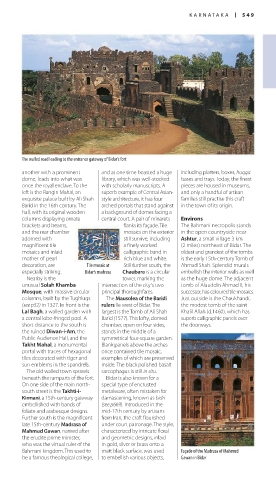
The walled road leading to the entrance gateway of Bidar’s fort
another with a prominent and at one time boasted a huge including platters, boxes, huqqa
dome, leads into what was library, which was well-stocked bases and trays. Today, the finest
once the royal enclave. To the with scholarly manuscripts. A pieces are housed in museums,
left is the Rangin Mahal, an superb example of Central Asian- and only a handful of artisan
exquisite palace built by Ali Shah style architecture, it has four families still practise this craft
Barid in the 16th century. The arched portals that stand against in the town of its origin.
hall, with its original wooden a background of domes facing a
columns displaying ornate central court. A pair of minarets Environs
brackets and beams, flanks its façade. Tile The Bahmani necropolis stands
and the rear chamber mosaics on the exterior in the open countryside near
adorned with still survive, including Ashtur, a small village 3 km
magnificent tile a finely worked (2 miles) northeast of Bidar. The
mosaics and inlaid calligraphic band in oldest and grandest of the tombs
mother-of-pearl rich blue and white. is the early 15th-century Tomb of
decoration, are Tile mosaic at Still further south, the Ahmad Shah. Splendid murals
especially striking. Bidar’s madrasa Chaubara is a circular embellish the interior walls as well
Nearby is the tower, marking the as the huge dome. The adjacent
unusual Solah Khamba intersection of the city ‘s two tomb of Alauddin Ahmad II, his
Mosque, with massive circular principal thoroughfares. successor, has coloured tile mosaics.
columns, built by the Tughluqs The Mausolea of the Baridi Just outside is the Chaukhandi,
(see p52) in 1327. In front is the rulers lie west of Bidar. The the modest tomb of the saint
Lal Bagh, a walled garden with largest is the Tomb of Ali Shah Khalil Allah (d.1460), which has
a central lobe-fringed pool. A Barid (1577). This lofty, domed superb calligraphic panels over
short distance to the south is chamber, open on four sides, the doorways.
the ruined Diwan-i-Am, the stands in the middle of a
Public Audience Hall, and the symmetrical four-square garden.
Takht Mahal, a monumental Blank panels above the arches
portal with traces of hexagonal once contained tile mosaic,
tiles decorated with tiger and examples of which are preserved
sun emblems in the spandrels. inside. The black polished basalt
The old walled town sprawls sarcophagus is still in situ.
beneath the ramparts of the fort. Bidar is also known for a
On one side of the main north- special type of encrusted
south street is the Takhti-i- metalware, often mistaken for
Kirmani, a 15th-century gateway damascening, known as bidri
embellished with bands of (see p669). Introduced in the
foliate and arabesque designs. mid-17th century by artisans
Further south is the magnificent from Iran, the craft flourished
late 15th-century Madrasa of under court patronage. The style,
Mahmud Gawan, named after characterized by intricate floral
the erudite prime minister, and geometric designs, inlaid
who was the virtual ruler of the in gold, silver or brass onto a
Bahmani kingdom. This used to matt black surface, was used Façade of the Madrasa of Mahmud
be a famous theological college, to embellish various objects, Gawan in Bidar
548-549_EW_India.indd 549 26/04/17 11:48 am

