


Page 550 - (DK Eyewitness) Travel Guide - India
P. 550
548 SOUTHWESTERN INDIA
with small chambers now
converted into dwellings. This
leads to a series of gateways
shielded by walls that protrude
outwards from the fort walls.
To the west of the fort are the
derelict tombs of the early
Bahmani sultans.
Another 14th-century
monument is the Shah Bazaar
Mosque, to the north of the
fort. Its domed entrance cham-
ber leads into a courtyard with
a prayer hall beyond. A street
from here proceeds westwards
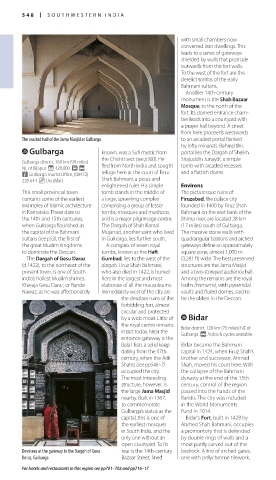
The vaulted hall of the Jama Masjid at Gulbarga to an arcaded portal flanked
by lofty minarets. Behind this
g Gulbarga known, was a Sufi mystic from portal lies the Dargah of Sheikh
the Chishti sect (see p380). He Sirajuddin Junaydi, a simple
Gulbarga district. 160 km (99 miles)
NE of Bijapur. * 428,000. £ @ fled from North India and sought tomb with arcaded recesses
n Gulbarga Tourist Office, (08472) refuge here at the court of Firuz and a flattish dome.
220 644. _ Urs (Mar). Shah Bahmani, a pious and
enlightened ruler. His simple Environs
This small provincial town tomb stands in the middle of The picturesque ruins of
contains some of the earliest a large, sprawling complex Firuzabad, the palace city
examples of Islamic architecture comprising a group of lesser founded in 1400 by Firuz Shah
in Karnataka. These date to tombs, mosques and madra sas, Bahmani on the east bank of the
the 14th and 15th centuries, and is a major pilgrimage centre. Bhima river, are located 28 km
when Gulbarga flourished as The Dargah of Shah Kamal (17 miles) south of Gulbarga.
the capital of the Bahmani Mujarrad, another saint who lived The massive stone walls with
sultans (see p53), the first of in Gulbarga, lies further south. quadrangular bastions and arched
the great Muslim kingdoms A complex of seven royal gateways define an approximately
to dominate the Deccan. tombs, known as the Haft square zone, almost 1,000 m
The Dargah of Gesu Daraz Gumbad, lies to the west of the (3,281 ft) wide. The best preserved
(d.1422), to the northeast of the dargah. Firuz Shah Bahmani, structures are the Jama Masjid
present town, is one of South who also died in 1422, is buried and a two-storeyed audience hall.
India’s holiest Muslim shrines. here in the largest and most Among the remains are the royal
Khwaja Gesu Daraz, or Bande elaborate of all the mausoleums. baths (hamams), with pyramidal
Nawaz, as he was affectionately Immediately west of the city are vaults and fluted domes, said to
the desolate ruins of the be the oldest in the Deccan.
forbidding fort, almost
circular and protected
by a wide moat. Little of h Bidar
the royal centre remains Bidar district. 120 km (75 miles) NE of
intact today. Near the Gulbarga. @ Autos & cycles available.
entrance gateway is the
Bala Hisar, a solid keep Bidar became the Bahmani
dating from the 17th capital in 1424, when Firuz Shah’s
century, when the Adil brother and successor, Ahmad
Shahis (see pp546–7) Shah, moved his court here. With
occupied the city. the collapse of the Bahmani
The most interesting dynasty at the end of the 15th
structure, however, is century, control of the region
the large Jama Masjid passed into the hands of the
nearby. Built in 1367, Baridis. The city was included
to commemorate in the World Monuments
Gulbarga’s status as the Fund in 2014.
capital, this is one of Bidar’s Fort, built in 1428 by
the earliest mosques Ahmed Shah Bahmani, occupies
in South India, and the a promontory that is defended
only one without an by double rings of walls and a
open courtyard. To its moat partly carved out of the
Devotees at the gateway to the Dargah of Gesu rear is the 14th-century bedrock. A trio of arched gates,
Daraz, Gulbarga Bazaar Street, lined one with polychrome tilework,
For hotels and restaurants in this region see pp701–702 and pp716–17
548-549_EW_India.indd 548 26/04/17 11:48 am
Eyewitness Travel LAYERS PRINTED:
Catalogue template “UK” LAYER
(Source v2.6)
Date 12th July 2013
Size 125mm x 217mm

