


Page 548 - (DK Eyewitness) Travel Guide - India
P. 548
546 SOUTHWESTERN INDIA
f Bijapur the Citadel is the
double-storeyed Asar
Bijapur district. 530 km (329 miles)
NW of Bengaluru. * 246,000. £ @ Mahal, built in 1646
n Karnataka Tourism, Station Rd, as the hall of justice,
(08352) 250 359. _ Bijapur Music and later converted
Festival (Feb/Mar), Gagan Mahal Urs into a sacred reliquary
Festival (Sep). to house two hairs
of the Prophet.
After the fall of the Bahmanis Chambers on the
(see p548), the Adil Shahi sultans upper level are
emerged as the principal rulers decorated with
of the Deccan in the 16th and murals depicting
17th cen turies. Their capital, floral themes and
the fortified city of Bijapur, was courtly scenes with
protected by ramparts with European-style
prominent bastions, and many figures. A short
of the original cannons are still distance away is
in place. The Malik-i-Maidan the elegant Mihtar
(“Lord of the Plain”), reput edly Mahal, from the
the largest cannon of the period period of Ibrahim II
in India, still guards the western (1580–1626) and
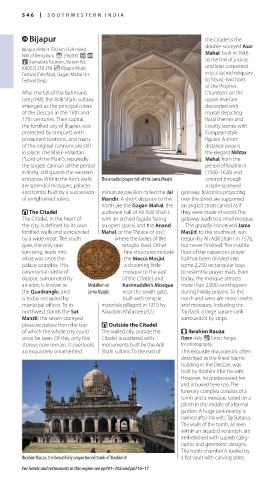
entrance. Within the fort’s walls The arcaded prayer hall of the Jama Masjid entered through
are splendid mosques, palaces a triple-storeyed
and tombs built by a succession miniature pavilion called the Jal gateway. Balconies projecting
of enlightened rulers. Mandir. A short distance to the over the street are supported
north are the Gagan Mahal, the on angled struts carved as if
T The Citadel audience hall of Ali Adil Shah I, they were made of wood. The
The Citadel, in the heart of with an arched façade facing gateway leads to a small mosque.
the city, is defined by its own an open space, and the Anand The grandly conceived Jama
fortified walls and surrounded Mahal, or the “Palace of Joy”, Masjid, to the southeast, was
by a wide moat. The south where the ladies of the begun by Ali Adil Shah I in 1576,
gate, the only one seraglio lived. Other but never finished. The marble
surviving, leads into fine structures include floor of the capacious prayer
what was once the the Mecca Masjid, hall has been divided into
palace complex. This a charming little some 2,250 rectangular bays
ceremonial centre of mosque to the east to resemble prayer mats. Even
Bijapur, surrounded by of the Citadel, and today, the mosque attracts
arcades, is known as Medallion at Karimuddin’s Mosque more than 2,000 worshippers
the Quadrangle, and Jama Masjid near the south gate, during Friday prayers. To the
is today occupied by built with temple north and west are more tombs
municipal offices. To its materials pillaged in 1310 by and mosques, including the
northwest stands the Sat Alauddin Khilji (see p52). Taj Baoli, a large square tank
Manzil, the seven-storeyed surrounded by steps.
pleasure palace from the top T Outside the Citadel
of which the whole city could The walled city, outside the Ibrahim Rauza
once be seen. Of this, only five Citadel, is scattered with Open daily. & Extra charges
storeys now remain. It overlooks monuments built by the Adil for photography.
an exquisitely ornamented Shahi sultans. To the east of This exquisite mausoleum, often
described as the finest Islamic
building in the Deccan, was
built by Ibrahim II for his wife.
However, he predeceased her
and is buried here too. The
funerary complex consists of a
tomb and a mosque, raised on a
plinth in the middle of a formal
garden. A huge tank nearby is
named after his wife, Taj Sultana.
The walls of the tomb, as seen
within an arcaded verandah, are
embellished with superb callig-
raphic and geometric designs.
The tomb chamber is roofed by
Ibrahim Rauza, the beautifully proportioned tomb of Ibrahim II a flat vault with curving sides.
For hotels and restaurants in this region see pp701–702 and pp716–17
546-547_EW_India.indd 546 26/04/17 11:48 am
Eyewitness Travel LAYERS PRINTED:
Catalogue template “UK” LAYER
(Source v2.6)
Date 12th July 2013
Size 125mm x 217mm

