


Page 549 - (DK Eyewitness) Travel Guide - India
P. 549
K ARNA T AK A 547
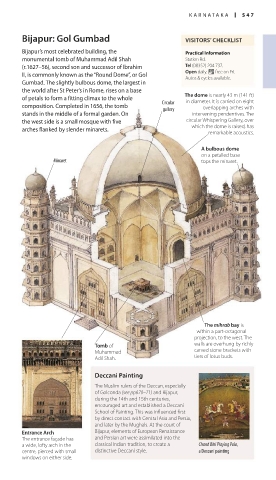
Bijapur: Gol Gumbad VISITORS’ CHECKLIST
Bijapur’s most celebrated building, the Practical Information
monumental tomb of Muhammad Adil Shah Station Rd.
(r.1627–56), second son and successor of Ibrahim Tel (08352) 204 737.
II, is commonly known as the “Round Dome”, or Gol Open daily. & free on Fri.
Autos & cycles available.
Gumbad. The slightly bulbous dome, the largest in
the world after St Peter’s in Rome, rises on a base
of petals to form a fitting climax to the whole The dome is nearly 43 m (141 ft)
in diameter. It is carried on eight
composition. Completed in 1656, the tomb Circular over lapping arches with
gallery
stands in the middle of a formal garden. On intervening pendentives. The
the west side is a small mosque with five circular Whispering Gallery, over
arches flanked by slender minarets. which the dome is raised, has
remarkable acoustics.
A bulbous dome
on a petalled base
Minaret tops the minaret.
The mihrab bay is
within a part-octagonal
projection, to the west. The
Tomb of walls are overhung by richly
Muhammad carved stone brackets with
Adil Shah. tiers of lotus buds.
Deccani Painting
The Muslim rulers of the Deccan, especially
of Golconda (see pp670–71) and Bijapur,
during the 14th and 15th cen turies,
encouraged art and established a Deccani
School of Painting. This was influenced first
by direct contact with Central Asia and Persia,
and later by the Mughals. At the court of
Entrance Arch Bijapur, elements of European Renaissance
The entrance façade has and Persian art were assimilated into the
a wide, lofty arch in the classical Indian tradition, to create a Chand Bibi Playing Polo,
centre, pierced with small distinctive Deccani style. a Deccani painting
windows on either side.
546-547_EW_India.indd 547 26/04/17 11:48 am

