


Page 590 - (DK Eyewitness) Travel Guide - India
P. 590
588 SOUTH INDIA
4 Vellore
Vellore district. 145 km (90 miles) W
of Chennai. * 3,936,331. £ Katpadi,
5 km (3 miles) N of town centre, then
bus or auto. @ ( daily.
Surrounded by a deep artificial
moat, the 16th-century Vellore
Fort dominates the heart of
this town. An impressive
example of military
architecture, the fort has
a turbulent history. This
formidable structure has
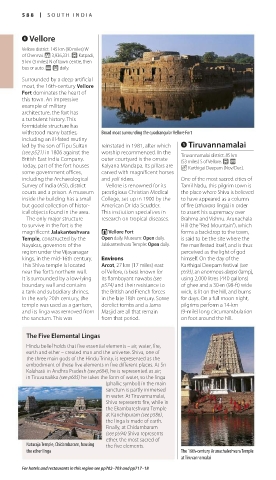
withstood many battles, Broad moat surrounding the quadrangular Vellore Fort
including an ill-fated mutiny
led by the son of Tipu Sultan reinstated in 1981, after which 5 Tiruvannamalai
(see p521) in 1806 against the worship recommenced. In the Tiruvannamalai district. 85 km
British East India Company. outer courtyard is the ornate (53 miles) S of Vellore. £ @
Today, part of the fort houses Kalyana Mandapa. Its pillars are _ Karthigai Deepam (Nov/Dec).
some government offices, carved with magnificent horses
including the Archaeological and yali riders. One of the most sacred cities of
Survey of India (ASI), district Vellore is renowned for its Tamil Nadu, this pilgrim town is
courts and a prison. A museum prestigious Christian Medical the place where Shiva is believed
inside the building has a small College, set up in 1900 by the to have appeared as a column
but good collection of histor- American Dr Ida Scudder. of fire (sthavara linga) in order
ical objects found in the area. This instiution specializes in to assert his supremacy over
The only major structure research on tropical diseases. Brahma and Vishnu. Arunachala
to survive in the fort is the Hill (the “Red Mountain”), which
magnificent Jalakanteshvara T Vellore Fort forms a backdrop to the town,
Temple, constructed by the Open daily. Museum: Open daily. is said to be the site where the
Nayakas, governors of the Jalakanteshvara Temple: Open daily. fire manifested itself, and is thus
region under the Vijayanagar perceived as the light of god
kings, in the mid-16th century. Environs himself. On the day of the
This Shiva temple is located Arcot, 27 km (17 miles) east Karthigai Deepam festival (see
near the fort’s northern wall. of Vellore, is best known for p593), an enormous deepa (lamp),
It is surrounded by a low-lying its flamboyant nawabs (see using 2,000 litres (440 gallons)
boundary wall and contains p574) and their resistance to of ghee and a 30-m (98-ft) wide
a tank and subsidiary shrines. the British and French forces wick, is lit on the hill, and burns
In the early 20th century, the in the late 18th century. Some for days. On a full moon night,
temple was used as a garrison, derelict tombs and a Jama pilgrims perform a 14-km
and its linga was removed from Masjid are all that remain (9-mile) long circumambulation
the sanctum. This was from that period. on foot around the hill.
The Five Elemental Lingas
Hindu belief holds that five essential elements – air, water, fire,
earth and ether – created man and the universe. Shiva, one of
the three main gods of the Hindu Trinity, is represented as the
embodiment of these five elements in five different places. At Sri
Kalahasti in Andhra Pradesh (see p684), he is represented as air;
in Tiruvanaikka (see p605) he takes the form of water, so the linga
(phallic symbol) in the main
sanctum is partly immersed
in water. At Tiruvannamalai,
Shiva represents fire, while in
the Ekambareshvara Temple
at Kanchipuram (see p586),
the linga is made of earth.
Finally, at Chidambaram
(see p594) Shiva represents
ether, the most sacred of
Nataraja Temple, Chidambaram, housing the five elements.
the ether linga The 16th-century Arunachaleshvara Temple
at Tiruvannamalai
For hotels and restaurants in this region see pp702–703 and pp717–18
588-589_EW_India.indd 588 26/04/17 11:49 am
Eyewitness Travel LAYERS PRINTED:
Catalogue template “UK” LAYER
(Source v2.6)
Date 12th July 2013
Size 125mm x 217mm

