


Page 589 - (DK Eyewitness) Travel Guide - India
P. 589
T A MIL NADU 587
Kanchipuram Silk
Initially, Kanchipuram was a weaving and trade centre for cotton textiles. But from
the 19th century, with the increase in availability of mulberry silk from neighbouring
Karnataka, the craftsmen turned entirely to silk weaving. Today, the silk fabric and
saris created by the city’s weavers and dyers are ritually offered to the gods before
being sold. Kanchipuram silks, an essential part of every Indian bride’s trousseau,
are renowned for their lustre, and for their elegant combination of contrasting
colours on the borders and end pieces (pallavs).
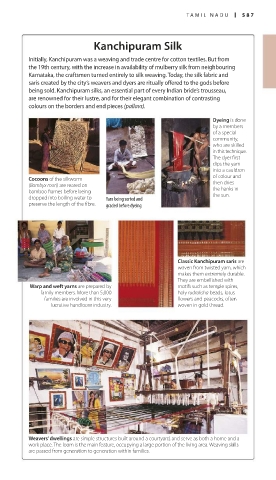
Dyeing is done
by a members
of a special
community,
who are skilled
in this technique.
The dyer first
dips the yarn
into a cauldron
Cocoons of the silkworm of colour and
then dries
(Bombyx mori) are reared on the hanks in
bamboo frames before being the sun.
dropped into boiling water to Yarn being sorted and
preserve the length of the fibre. graded before dyeing
Classic Kanchipuram saris are
woven from twisted yarn, which
makes them extremely durable.
They are embellished with
Warp and weft yarns are prepared by motifs such as temple spires,
family members. More than 5,000 holy rudraksha beads, lotus
families are involved in this very flowers and peacocks, often
lucrative handloom industry. woven in gold thread.
Weavers’ dwellings are simple structures built around a courtyard, and serve as both a home and a
work place. The loom is the main feature, occupying a large portion of the living area. Weaving skills
are passed from generation to generation within families.
586-587_EW_India.indd 587 26/04/17 11:49 am

