


Page 591 - (DK Eyewitness) Travel Guide - India
P. 591
T A MIL NADU 589
Arunachaleshvara Temple, the
town’s most important structure,
is one of the five elemental shrines
of Shiva, where the linga,
encased in gold, represents fire.
Covering a vast area of 10 ha
(25 acres), this is also one of the
largest temple complexes in
India, parts of it dating to the 11th
century. It has nine imposing
towers, huge prakaras (walled
and cloistered enclosures), the
large Shivaganga Tank and a
vast thousand-pillared hall.
Tiruvannamalai is also
where Sri Ramana Maharshi,
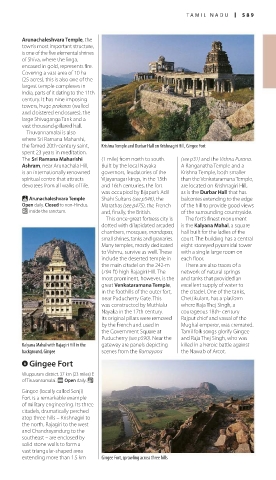
the famed 20th-century saint, Krishna Temple and Durbar Hall on Krishnagiri Hill, Gingee Fort
spent 23 years in meditation.
The Sri Ramana Maharishi (1 mile) from north to south. (see p31) and the Vishnu Purana.
Ashram, near Arunachala Hill, Built by the local Nayaka A Ranganatha Temple and a
is an internationally renowned governors, feudatories of the Krishna Temple, both smaller
spiritual centre that attracts Vijayanagar kings, in the 15th than the Venkataramana Temple,
devotees from all walks of life. and 16th centuries, the fort are located on Krishnagiri Hill,
was occupied by Bijapur’s Adil as is the Durbar Hall that has
Arunachaleshvara Temple Shahi Sultans (see p546), the balconies extending to the edge
Open daily. Closed to non-Hindus. Marathas (see p475), the French of the hill to provide good views
^ inside the sanctum. and, finally, the British. of the surrounding countryside.
This once-great fortress city is The fort’s finest monument
dotted with dilapidated arcaded is the Kalyana Mahal, a square
chambers, mosques, mandapas, hall built for the ladies of the
small shrines, tanks and granaries. court. The building has a central
Many temples, mostly dedicated eight-storeyed pyra midal tower
to Vishnu, survive as well. These with a single large room on
include the deserted temple in each floor.
the main citadel on the 242-m There are also traces of a
(794-ft) high Rajagiri Hill. The network of natural springs
most prominent, however, is the and tanks that provided an
great Venkataramana Temple, excellent supply of water to
in the foothills of the outer fort, the citadel. One of the tanks,
near Puducherry Gate. This Chettikulam, has a platform
was constructed by Muthialu where Raja Thej Singh, a
Nayaka in the 17th century. courageous 18th- century
Its original pillars were removed Rajput chief and vassal of the
by the French and used in Mughal emperor, was cremated.
the Government Square at Tamil folk songs glorify Gingee
Puducherry (see p590). Near the and Raja Thej Singh, who was
Kalyana Mahal with Rajagiri Hill in the gateway are panels depicting killed in a heroic battle against
background, Gingee scenes from the Ramayana the Nawab of Arcot.
6 Gingee Fort
Viluppuram district. 37 km (23 miles) E
of Tiruvannamalai. @ Open daily. &
Gingee (locally called Senji)
Fort is a remarkable example
of military engineering. Its three
citadels, dramatically perched
atop three hills – Krishnagiri to
the north, Rajagiri to the west
and Chandrayandurg to the
southeast – are enclosed by
solid stone walls to form a
vast triangular-shaped area
extending more than 1.5 km Gingee Fort, sprawling across three hills
588-589_EW_India.indd 589 26/04/17 11:49 am

