


Page 601 - (DK Eyewitness) Travel Guide - India
P. 601
T A MIL NADU 599
Carnatic Music
The classical music of South India is known as Carnatic music. Though based
on the general concepts of raga (melody) and tala (rhythm) found in Hindustani
music (see pp32–3), Carnatic music differs in many respects. It is almost exclusively
devotional in character, uses different percussion and musical instruments, and
develops the melody in a more structured manner. It also lays more emphasis
on rhythm. Some of the greatest Carnatic music was composed between 1750
and 1850, by the musical trinity of Thyagaraja, Syama Sastri, and Muthuswami
Dikshitar, who, between them, wrote over 2,500 songs in Sanskrit and Telegu,
modifying and refining features that are now essential to the genre.
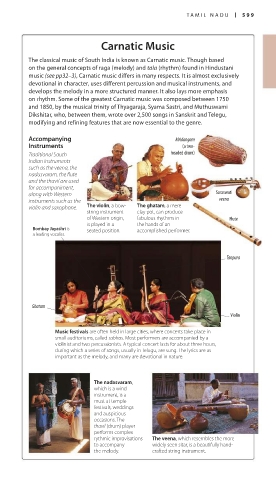
Accompanying Mridangam
Instruments (a two-
Traditional South headed drum)
Indian instruments
such as the veena, the
nadasvaram, the flute
and the thavil are used
for accompaniment,
along with Western Saraswati
instruments such as the veena
violin and saxophone. The violin, a bow- The ghatam, a mere
string instrument clay pot, can produce
of Western origin, fabulous rhythms in Flute
is played in a the hands of an
Bombay Jayashri is seated position. accomplished performer.
a leading vocalist.
Tanpura
Ghatam
Violin
Music festivals are often held in large cities, where concerts take place in
small auditoriums, called sabhas. Most performers are accompanied by a
violinist and two percussionists. A typical concert lasts for about three hours,
during which a series of songs, usually in Telugu, are sung. The lyrics are as
important as the melody, and many are devotional in nature.
The nadasvaram,
which is a wind
instrument, is a
must at temple
festivals, weddings
and auspicious
occasions. The
thavil (drum) player
performs complex
rythmic improvisations The veena, which resembles the more
to accompany widely seen sitar, is a beautifully hand-
the melody. crafted string instrument.
598-599_EW_India.indd 599 26/04/17 11:49 am

