


Page 93 - (DK Eyewitness) Travel Guide - India
P. 93
DELHI 91
was taken away as war booty by
the Persian chieftain Nadir Shah
in 1739. The walls and pillars of
this exclusive pavilion, where
the emperor met his most-
trusted nobles, were once inlaid
with gems. The ceiling was of
silver inlaid with precious stones.
A little further away are the
Hamams (Royal Baths) with
inlaid marble floors and three
enclosures. The first chamber
provided hot vapour, the
second scented rosewater
through sculpted fountains,
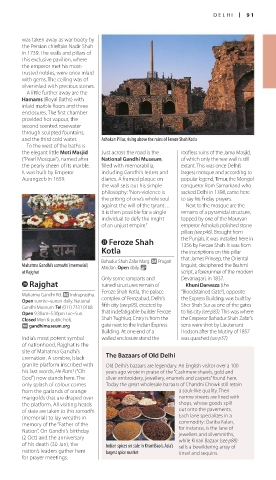
and the third cold water. Ashokan Pillar, rising above the ruins of Feroze Shah Kotla
To the west of the baths is
the elegant little Moti Masjid Just across the road is the roofless ruins of the Jama Masjid,
(“Pearl Mosque”), named after National Gandhi Museum, of which only the rear wall is still
the pearly sheen of its marble. filled with memorabilia, extant. This was once Delhi’s
It was built by Emperor including Gandhi’s letters and largest mosque and according to
Aurangzeb in 1659. diaries. A framed plaque on popular legend, Timur, the Mongol
the wall sets out his simple conqueror from Samarkand who
philosophy: “Non-violence is sacked Delhi in 1398, came here
the pitting of one’s whole soul to say his Friday prayers.
against the will of the tyrant… Next to the mosque are the
it is then possible for a single remains of a pyramidal structure,
individual to defy the might topped by one of the Mauryan
of an unjust empire.” emperor Ashoka’s polished stone
pillars (see p46). Brought from
a Feroze Shah the Punjab, it was installed here in
1356 by Feroze Shah. It was from
Kotla the inscriptions on this pillar
that James Prinsep, the Oriental
Bahadur Shah Zafar Marg. q Pragati
Mahatma Gandhi’s samadhi (memorial) Maidan. Open daily. & linguist, deciphered the Brahmi
at Rajghat script, a forerunner of the modern
Only some ramparts and Devanagari, in 1837.
p Rajghat ruined structures remain of Khuni Darwaza (the
Feroze Shah Kotla, the palace “Bloodstained Gate”), opposite
Mahatma Gandhi Rd. q Indraprastha.
Open sunrise–sunset daily. National complex of Ferozabad, Delhi’s the Express Building, was built by
Gandhi Museum: Tel (011) 2331 0168. fifth city (see p95), erected by Sher Shah Sur as one of the gates
Open 9:30am–5:30pm Tue–Sun. that indefatigable builder Feroze to his city (see p83). This was where
Closed Mon & public hols. Shah Tughluq. Entry is from the the Emperor Bahadur Shah Zafar’s
∑ gandhimuseum.org gate next to the Indian Express sons were shot by Lieutenant
Building. At one end of a Hodson after the Mutiny of 1857
India’s most potent symbol walled enclosure stand the was quashed (see p57).
of nationhood, Rajghat is the
site of Mahatma Gandhi’s
cremation. A sombre, black The Bazaars of Old Delhi
granite platform inscribed with Old Delhi’s bazaars are legendary. An English visitor over a 100
his last words, He Ram! (“Oh years ago wrote in praise of the “Cashmere shawls, gold and
God”) now stands here. The silver embroidery, jewellery, enamels and carpets” found here.
only splash of colour comes Today the great wholesale bazaars of Chandni Chowk still retain
from the garlands of orange a souk-like quality. Their
marigolds that are draped over narrow streets are lined with
the platform. All visiting heads shops, whose goods spill
of state are taken to this samadhi out onto the pavements.
(memorial) to lay wreaths in Each lane specializes in a
memory of the “Father of the commodity: Dariba Kalan,
Nation”. On Gandhi’s birthday for instance, is the lane of
jewellers and silversmiths,
(2 Oct) and the anniversary while Kinari Bazaar (see p88)
of his death (30 Jan), the Indian spices on sale in Khari Baoli, Asia’s sells a bewildering array of
nation’s leaders gather here largest spice market tinsel and sequins.
for prayer meetings.
090-091_EW_India.indd 91 26/04/17 11:42 am

