


Page 95 - (DK Eyewitness) Travel Guide - India
P. 95
DELHI 93
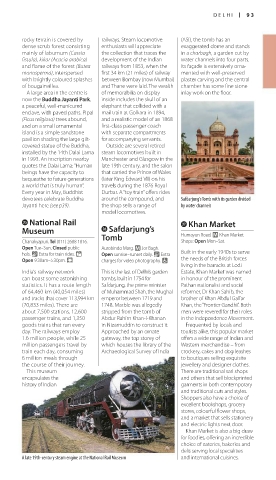
rocky terrain is covered by railways. Steam locomotive (ASI), the tomb has an
dense scrub forest consisting enthusiasts will appreciate exaggerated dome and stands
mainly of laburnum (Cassia the collection that traces the in a charbagh, a garden cut by
fistula), kikar (Acacia arabica) development of the Indian water channels into four parts.
and flame of the forest (Butea railways from 1853, when the Its façade is extensively orna-
monosperma), interspersed first 34 km (21 miles) of railway mented with well-preserved
with brightly coloured splashes between Bombay (now Mumbai) plaster carving and the central
of bougainvillea. and Thane were laid. The wealth chamber has some fine stone
A large area in the centre is of memorabilia on display inlay work on the floor.
now the Buddha Jayanti Park, inside includes the skull of an
a peaceful, well-manicured elephant that collided with a
enclave, with paved paths. Pipal mail train at Golkara in 1894,
(Ficus religiosa) trees abound, and a realistic model of an 1868
and on a small ornamental first-class passenger coach
island is a simple sandstone with separate compartments
pavilion shading the large gilt- for accompanying servants.
covered statue of the Buddha, Outside are several retired
installed by the 14th Dalai Lama steam locomotives built in
in 1993. An inscription nearby Manchester and Glasgow in the
quotes the Dalai Lama: “Human late 19th century, and the salon
beings have the capacity to that carried the Prince of Wales
bequeathe to future generations (later King Edward VII) on his
a world that is truly human”. travels during the 1876 Royal
Every year in May, Buddhist Durbar. A “toy train” offers rides
devotees celebrate Buddha around the compound, and Safdarjung’s Tomb with its garden divided
Jayanti here (see p39). the shop sells a range of by water channels
model locomotives.
g National Rail j Khan Market
Museum h Safdarjung’s Humayun Road. q Khan Market.
Chanakyapuri. Tel (011) 2688 1816. Tomb Shops: Open Mon–Sat.
Open Tue–Sun. Closed public Aurobindo Marg. q Jor Bagh.
hols. & Extra for train rides. = Open sunrise–sunset daily. & Extra Built in the early 1940s to serve
Open 9:30am–5:30pm. 9 charges for video photography. 7 the needs of the British forces
living in the barracks at Lodi
India’s railway network This is the last of Delhi’s garden Estate, Khan Market was named
can boast some astonishing tombs, built in 1754 for in honour of the prominent
statistics. It has a route length Safdarjung, the prime minister Pathan nationalist and social
of 64,460 km (40,054 miles) of Muhammad Shah, the Mughal reformer, Dr Khan Sahib, the
and tracks that cover 113,994 km emperor between 1719 and brother of Khan Abdul Gaffar
(70,833 miles). There are 1748. Marble was allegedly Khan, the “Frontier Gandhi”. Both
about 7,500 stations, 12,600 stripped from the tomb of men were revered for their roles
passenger trains, and 1,350 Abdur Rahim Khan-i-Khanan in the Independence Movement.
goods trains that run every in Nizamuddin to construct it. Frequented by locals and
day. The railways employ Approached by an ornate tourists alike, this popular market
1.6 million people, while 25 gateway, the top storey of offers a wide range of Indian and
million passengers travel by which houses the library of the Western merchandise – from
train each day, consuming Archaeological Survey of India crockery, cakes and dog leashes
6 million meals through to boutiques selling exquisite
the course of their journey. jewellery and designer clothes.
This museum There are traditional sari shops
encapsulates the and others that sell blockprinted
history of Indian garments in both contemporary
and traditional cuts and styles.
Shoppers also have a choice of
excellent bookshops, grocery
stores, colourful flower shops,
and a market that sells stationery
and electric lights next door.
Khan Market is also a big draw
for foodies, offering an incredible
choice of eateries, bakeries and
delis serving local specialities
A late 19th-century steam engine at the National Rail Museum and international cuisines.
092-093_EW_India.indd 93 05/05/17 3:55 pm

