


Page 94 - (DK Eyewitness) Travel Guide - India
P. 94
92 DELHI & THE NOR TH
s Around
Kashmiri Gate
Between Nicholson Rd, Ramlal
Chandok Marg & Church Rd.
q Kashmiri Gate. St James’ Church:
Lothian Rd. Tel (011) 2386 0873.
Open daily. 5 English: 8:30am
(summer), 9am Sun.
This landmark, from where
the Mughals would set off to
spend their summers in Kashmir,
resonates with memories of
the Mutiny of 1857 (see p57).
The short stretch between
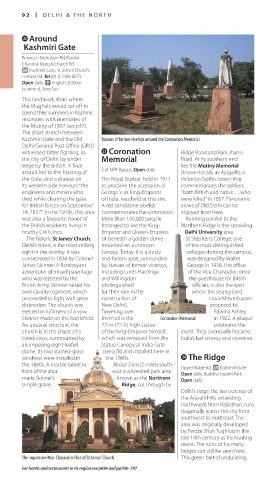
Kashmiri Gate and the Old Statues of former viceroys around the Coronation Memorial
Delhi General Post Office (GPO)
witnessed bitter fighting, as d Coronation Ridge Road and Rani Jhansi
the city of Delhi lay under Memorial Road. At its southern end
siege by the British. A final lies the Mutiny Memorial
assault led to the blasting of S of NH1 Bypass. Open daily. (known locally as Ajitgarh), a
the Gate, and a plaque on The Royal Durbar, held in 1911 Victorian Gothic tower that
its western side honours “the to proclaim the accession of commemorates the soldiers
engineers and miners who George V as King-Emperor “both British and native… who
died while clearing the gate of India, was held at this site. were killed” in 1857. Panoramic
for British forces on September A red sandstone obelisk views of Old Delhi can be
14, 1857”. In the 1920s, this area commemorates the coronation. enjoyed from here.
was also a favourite haunt of More than 100,000 people Running parallel to the
the British residents living in thronged to see the King- Northern Ridge is the sprawling
nearby Civil Lines. Emperor and Queen-Empress Delhi University area.
The historic St James’ Church, sit beneath a golden dome St Stephen’s College, one
Delhi’s oldest, is the most striking mounted on a crimson of the most distinguished
sight in the vicinity. It was canopy. Today, it is a dusty colleges dotting the campus,
consecrated in 1836 by Colonel and forlorn spot, surrounded was designed by Walter
James Skinner. A flamboyant by statues of former viceroys, George in 1938. The office
adventurer of mixed parentage including Lords Hardinge of the Vice Chancellor, once
who was rejected by the and Willingdon the guesthouse for British
British Army, Skinner raised his (distinguished officials, is also the spot
own cavalry regiment, which for their role in the where the young Lord
proceeded to fight with great construction of Louis Mountbatten
distinction. The church was New Delhi). proposed to
erected in fufilment of a vow Towering over Edwina Ashley
Skinner made on the battlefield. them all is the Coronation Memorial in 1922. A plaque
An unusual structure, the 22-m (72-ft) high statue celebrates the
church is in the shape of a of the King-Emperor himself, event. They eventually became
Greek cross, surmounted by which was removed from the India’s last viceroy and vicereine.
an imposing eight-leafed Statue Canopy at India Gate
dome. Its two stained-glass (see p78) and installed here in
windows were installed in the 1960s. f The Ridge
the 1860s. A marble tablet in About 3 km (2 miles) south- Upper Ridge Rd. q Kashmiri Gate.
front of the altar east is a forested park area Open daily. Buddha Jayanti Park:
marks Skinner’s known as the Northern Open daily.
simple grave. Ridge, cut through by
Delhi’s ridge, the last outcrop of
the Aravalli Hills extending
northwards from Rajasthan, runs
diagonally across the city from
southwest to northeast. The
area was originally developed
by Feroze Shah Tughluq in the
late 14th century as his hunting
resort. The ruins of his many
lodges can still be seen here.
The impressive Neo-Classical edifice of St James’ Church This green belt of undulating,
For hotels and restaurants in tis region see p694 and pp706–707
092-093_EW_India.indd 92 04/05/17 3:23 pm

