


Page 161 - (DK Eyewitness) Travel Guide: Japan
P. 161
JAP AN REGION B Y REGION 159
KYOTO CITY
To truly understand Japan, the visitor must spend time in the backstreets
and environs of its old imperial capital, where scores of the country’s famous
monuments are preserved within a lively modern city. Kyoto’s citizens may
grudgingly envy the eco nomic vitality of Tokyo and nearby Osaka, but they take
great pride in their refined cuisine, lilting dialect, and sensitivity to the seasons.
Founded in 794 as Heian-kyo (capital the tea ceremony. Merchants were also
of peace and tranqui lity), the city influential, especially the silk weavers
was modeled on the Tang Chinese of Nishijin. The city was reduced to ashes
city of Chang-an. Bounded on three at various times by earthquakes, fires,
sides by mountains and bisected by and the ten-year period of civil strife
a river flowing north to south, the site known as the Onin War (1467–77). During
was considered ideal by Emperor the Edo period (1603–1868), the balance
Kanmu’s geo mancers. As the population of power shifted from Kyoto to Edo
grew, however, hygiene was a problem, (Tokyo), and Kyoto eventually lost its
especially when the Kamo River status as capital in 1869. At first glance,
flooded. A series of rituals and festivals modern Kyoto may seem little different
came into being to placate the spirits from other Japanese cities, but the
responsible for plagues and other pleasures of this repository of Japanese
catastrophes, result ing in a tightly culture will soon reveal themselves. Life
knit fabric of ritual and custom, mostly here is still largely tied to nature’s
still observed. rhythms, as can be gauged by visiting
Kyoto culture became an amalgam at differ ent times of the year. Kyo-ryori,
of several influences, of which the Kyoto’s celebrated cuisine, for exam ple,
imperial court and nobility were the first makes much of seasonality, and the city’s
and most important. Later came the exquisite gardens go through striking
samurai, patrons of Zen Buddhism, and seasonal transitions.
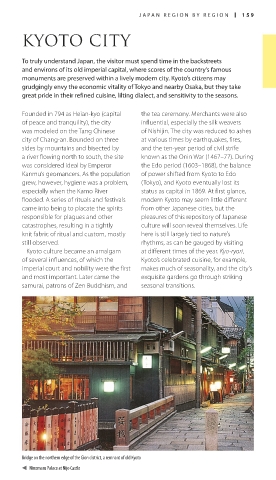
Bridge on the northern edge of the Gion district, a remnant of old Kyoto
Ninomaru Palace at Nijo Castle
158-159_EW_Japan.indd 159 08/08/16 3:07 pm

