


Page 164 - (DK Eyewitness) Travel Guide: Japan
P. 164
162 JAP AN REGION B Y REGION
1 Toji Temple 1997, the structure
Toji Temple is the work of
architect Hiroshi
@ 42 to Toji Higashimon-mae. Open
8:30am–5:30pm daily (4:30pm fall/ Hara, a former Tokyo
University professor
winter). & Museum: Tel (075) 691-
3325. Open phone for times. & whose design
triumphed in
Although it lacks the mossy an international
beauty of many Kyoto temples, competition.
dusty, hoary Toji (actual name Although it has
Kyo-o-gokoku-ji) impresses by been criticized for its
the sheer weight of its history. refusal to incorporate
Its Buddhas have been traditional Japanese
watching over the city ever motifs in its design,
since Kukai (see p233) founded the station is
the temple in 794. The city’s undeniably eye-
religious foundations were laid catching. Thanks
here, and echoes of bygone to its open-air
rituals seem to linger in Toji’s spaces it also
hallowed halls. ironically resembles
Kukai turned Toji into the a traditional wooden
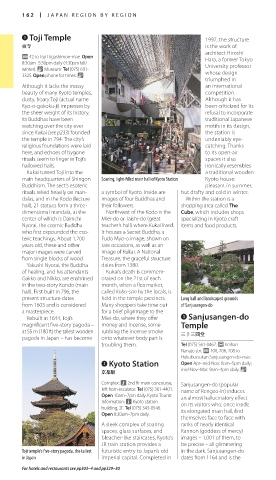
main headquarters of Shingon Soaring, light-filled main hall of Kyoto Station Kyoto house:
Buddhism. The sect’s esoteric pleasant in summer,
rituals relied heavily on man- a symbol of Kyoto. Inside are but drafty and cold in winter.
dalas, and in the Kodo (lec ture images of four Buddhas and Within the station is a
hall), 21 statues form a three- their followers. shopping area called The
dimensional mandala, at the Northwest of the Kodo is the Cube, which includes shops
center of which is Dainichi Miei-do or Taishi-do (great specializing in Kyoto craft
Nyorai, the cosmic Buddha teacher’s hall) where Kukai lived. items and food products.
who first expounded the eso- It houses a Secret Buddha, a
teric teachings. About 1,200 Fudo Myo-o image, shown on
years old, these and other rare occasions, as well as an
major images were carved image of Kukai. A National
from single blocks of wood. Treasure, the grace ful structure
Yakushi Nyorai, the Buddha dates from 1380.
of healing, and his attendants Kukai’s death is commem-
Gakko and Nikko, are en shrined orated on the 21st of each
in the two-story Kondo (main month, when a flea market,
hall). First built in 796, the called Kobo-san by the locals, is
present structure dates held in the temple precincts. Long hall and landscaped grounds
from 1603 and is considered Many shoppers take time out of Sanjusangen-do
a masterpiece. for a brief pilgrimage to the
Rebuilt in 1644, Toji’s Miei-do, where they offer 3 Sanjusangen-do
magnificent five-story pagoda – money and incense, some Temple
at 55 m (180 ft) the tallest wooden rubbing the incense smoke Sanjusangen-do Temple
pagoda in Japan – has become onto whatever body part is
troubling them. Tel (075) 561-0467. £ Keihan
Nanajo stn. @ 100, 206, 208 to
Hakubutsukan Sanjusangen-do-mae.
2 Kyoto Station Open Apr–mid-Nov: 8am–5pm daily;
mid-Nov–Mar: 9am–4pm daily. &
Kyoto Station
Complex: n 2nd flr main concourse, Sanjusangen-do (popular
left from escalator. Tel (075) 361-4401. name of Rengeo-in) induces
Open 10am–7pm daily. Kyoto Tourist an almost hallucinatory effect
Information: n Kyoto station on its visitors who, once inside
building, 2F. Tel (075) 343-0548. its elongated main hall, find
Open 8:30am–7pm daily.
themselves face to face with
A sleek complex of soaring ranks of nearly identical
spaces, glass surfaces, and Kannon (goddess of mercy)
bleacher-like staircases, Kyoto’s images – 1,001 of them, to
JR train station provides a be precise – all glimmering
Toji temple’s five-story pagoda, the tallest futuristic entry to Japan’s old in the dark. Sanjusangen-do
in Japan imperial capital. Completed in dates from 1164 and is the
For hotels and restaurants see pp303–4 and pp329–30
162-163_EW_Japan.indd 162 08/08/16 3:07 pm
Eyewitness Travel LAYERS PRINTED:
Catalogue template “UK” LAYER
(Source v2.6)
Date 12th July 2013
Size 125mm x 217mm

