


Page 185 - (DK Eyewitness) Travel Guide: Japan
P. 185
K Y O T O CIT Y 183
however, warlord Oda q Fushimi Inari from his daimyo (feudal lords).
Nobunaga, angered by the Shrine The rest of Daigo-ji is more
temple’s resistance to his ancient. The graceful five-
authority, sent his army to story pagoda, built in 951, is
attack the mountain. The 68 Yabunouchi, Fukakusa, Fushimi-ku. one of only two Heian-era
complex was burned to £ Fushimi-Inari stn, Keihan line; JR pagodas in existence. Those
Inari stn, Nara line. @ Minami 5 to
the ground, and every Fushimi Inari Taisha mae. Tel (075) venturing to upper Daigo
man, woman, and child 641-7331. Open 24 hours. are mainly pilgrims. The
massacred. white-clad ones are headed
The temple is divided into This most famous of the many for Juntei-do, a hall housing
three precincts, connected thousands of shrines dedicated a Kannon image – No. 11 of
by shuttle bus. The Kokuho- to Inari, the popular deity of rice the 33 Kannon Temples
den, a museum of treasures, and sake (see p30), is located pilgrimage route.
is in the east precinct. Here, near the sake-making district
too, is the famous Konpon of Fushimi. An avenue formed
Chu-do, the inner sanctum, out of several hundred torii e Uji City
which enshrines a Healing (gates) and leading up to Uji City
Buddha image said to have the shrine has been donated
been carved by Saicho. by businessmen. £ Uji stn, Keihan-Uji or Nara lines.
Nearby Jodo-in (Pure Byodo-in: Open 8:30am–5:30pm daily.
Manpuku-ji: Open 9am–4:30pm daily.
Land Hall) is the site of & Miho Museum: 300 Tashiro
Saicho’s tomb. Momodani, Shigaraki-cho, Shiga.
In the Jogyo-do hall in Tel (074) 882-3411. Open 10am–5pm
the west precinct monks Tue–Sun. & ∑ miho.or.jp
chant an invocation called
the nem butsu; in the Hokke- In addition to some of the best
do hall they meditate upon green tea grown in Japan, the
the Lotus Sutra, a central small city of Uji boasts Byodo-
tenet of Tendai belief. Beyond in, which is featured on the
these two buil dings is the 10-yen coin. Built in 1053, the
Shaka-do, the main hall of temple’s Phoenix Hall (see p34)
the west precinct. and Amida Nyorai image inside
Daigo-ji’s Heian-era pagoda are marvelous remnants of one
of Japan’s greatest epochs.
0 Ohara District w Daigo-ji Temple While Byodo-in sought to
imitate palaces depicted in Tang-
Ohara District Daigo-ji Temple
dynasty mandalas, Manpuku-ji
@ 17 from Kyoto stn. 22 Higashioji-cho, Daigo, Fushimi-ku. invoked the architectural
Daigo stn, Tozai line. Sanpo-in: traditions of Ming China. This
Known for thatched farm- Tel (075) 571-0002. Open 9am–4pm most Chinese of Kyoto temples
houses, delicious pickles, daily (to 5pm Mar–Dec). & was estab-lished in 1661 by
and other rustic charms, Ingen, a priest who fled China
Ohara is also home to two Daigo-ji’s main draw is after the fall of the Ming
famous temples. Set in an subtemple Sanpo-in. Because dynasty. Ingen introduced the
incomparably beautiful Toyo tomi Hideyoshi took a sencha, or leaf tea, ceremony.
setting, Sanzen-in’s Amida personal interest in resto ring Close by, in Shigaraki, the
Hall dates from 1148 and this after a visit in 1598, it contains Miho Museum has some fine
houses a meditating Amida some of the Momoyama period’s examples of Japan ese treasures
Buddha. Fusuma (sliding door) most representative works of such as Buddha statues and
paintings by Takeuchi Seiho art. The lavish garden is noted handscrolls, as well as Roman
(1864–1942) decorate the for its many magnificent rocks, mosaics and treasures from
temple’s Shinden. The which were gifts to Hideyoshi Egypt and Persia.
approach to Sanzen-in is
lined with shops selling such
local products as shiba-zuke,
a pickle dyed purple with the
leaf of the beefsteak plant.
Across the valley is tiny
Jakko-in, a nunnery where
Kenreimon-in (1155–1213)
lived. The sole survivor of the
Taira clan, she prayed here
for the souls of her son and
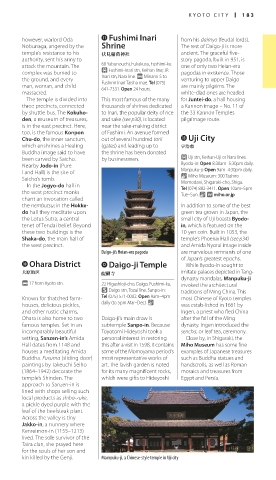
kin killed by the Genji. Mampuku-ji, a Chinese-style temple in Uji city
182-183_EW_Japan.indd 183 08/08/16 3:07 pm

