


Page 183 - (DK Eyewitness) Travel Guide: Japan
P. 183
K Y O T O CIT Y 181
3 Sagano District humble home of haiku poet
Mukai Kyorai (1651–1704).
Sagano District
Basho (see p283) composed
£ JR SagaArashiyama stn, Sagano
line. @ 28 or 91 to Daikakuji. his Saga Diary here in 1691.
Secluded Nichirensect
The home of rice fields, temple Jojakko-ji is situ ated
bam boo groves, temples, and on Ogurayama, a mountain
cemeteries, Sagano’s varied whose beauty has been
sights are by turn pastoral and celebrated by poets since
poignant. The best point from ancient times. A steep flight
which to launch an exploration of stone steps leads to the
is Torii Moto, where a vermil ion temple from where there
shrine gateway (torii) marks are great views of Kyoto
the beginning of an ancient and Mount Hiei. Halfway up
trail leading up to sacred the steps, a thatched gate
Mount Atago, abode of the houses two fierceeyed Nio
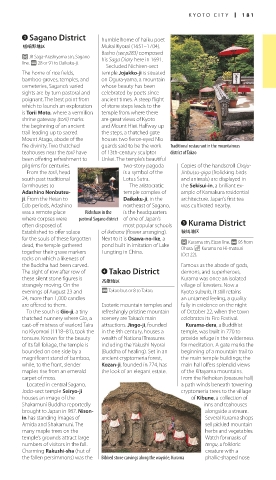
fire divinity. Two thatched guards said to be the work Traditional restaurant in the mountainous
teahouses near the torii have of 13thcentury sculptor district of Takao
been offering refreshment to Unkei. The temple’s beauti ful
pilgrims for centuries. twostory pago da Copies of the handscroll Choju-
From the torii, head is a symbol of the Jinbutsu-giga (frol icking birds
south past traditional Lotus Sutra. and animals) are displayed in
farm houses to The aristocratic the Sekisui-in, a brilliant ex
Adashino Nen butsu- temple complex of ample of Kamakura residential
ji. From the Heian to Daikaku-ji, in the architecture. Japan’s first tea
Edo peri ods, Adashino northeast of Saga no, was cultivated nearby.
was a remote place Rickshaw in the is the head quarters
where corpses were pastoral Sagano district of one of Japan’s 5 Kurama District
often disposed of. most popular schools
Estab lished to offer solace of ikebana (flower arranging). Karama District
for the souls of these forgotten Next to it is Osawa-no-Ike, a £ Kurama stn, Eizan line. @ 95 from
dead, the temple gathered pond built in imitation of Lake Ohara. _ Kurama no Himatsuri
together their grave markers – Tungting in China. (Oct 22).
rocks on which a likeness of
the Buddha had been carved. Famous as the abode of gods,
The sight of row after row of 4 Takao District demons, and superheroes,
Kurama was once an isolated
these silent stone figures is Takao District
strangely mov ing. On the village of foresters. Now a
evenings of August 23 and @ Takao bus or 8 to Takao. Kyoto suburb, it still retains
24, more than 1,000 candles an untamed feeling, a quality
are offered to them. Esoteric mountain temples and fully in evidence on the night
To the south is Gio-ji, a tiny refreshingly pristine mountain of October 22, when the town
thatched nunnery where Gio, a scenery are Takao’s main celebrates its Fire Festival.
castoff mistress of warlord Taira attractions. Jingo-ji, founded Kurama-dera, a Buddhist
no Kiyomori (1118–81), took the in the 9th century, houses a temple, was built in 770 to
tonsure. Known for the beauty wealth of National Treasures provide refuge in the wilder ness
of its fall foliage, the temple is including the Yaku shi Nyorai for meditation. A gate marks the
bounded on one side by a (Buddha of healing). Set in an beginning of a mountain trail to
magnificent stand of bamboo, ancient cryptomeria forest, the main temple buil dings; the
while, to the front, slender Kozan-ji, founded in 774, has main hall offers splendid views
maples rise from an emerald the look of an elegant estate. of the Kitayama mountains.
carpet of moss. From the Reihokan (treasure hall)
Located in central Sagano, a path winds beneath tow ering
Jodosect temple Seiryo-ji cryptomeria trees to the village
houses an image of the of Kibune, a collection of
Shakamuni Buddha reportedly inns and teahouses
brought to Japan in 987. Nison- alongside a stream.
in has standing images of Several Kurama shops
Amida and Shakamuni. The sell pickled mountain
many maple trees on the herbs and vegetables.
temple’s grounds attract large Watch for masks of
numbers of visitors in the fall. tengu, a folk loric
Charming Rakushi-sha (hut of creature with a
the fallen persimmons) was the Bibbed stone carvings along the wayside, Kurama phallicshaped nose.
180-181_EW_Japan.indd 181 08/08/16 3:07 pm

